So I took a few months off after all but burning myself out with Elektra, but I'm back and intend to be badder than ever. :)
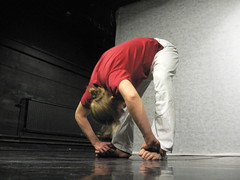
An interesting thing about physical burnout: it takes a long time to recover. Like two months even. I wouldn't say that I was really mentally burnt after last season, but I really had pushed my body to its limit. While Elektra closed in mid-May, I noticed during Kalevala warmups (it ran until June 20) that I was never even able to get my body to run properly. With jumps, balances, and basically especially stuff that involved the legs, I felt vaguely like I was in one of those dreams where the more you will yourself to run away from the knife-wielding, goalie-masked Jason, the more cemented your feet become to the ground. Eventually I learned to just take this as what was available to me now and take it easy until I got my power back, no matter how long that might take. Started taking some ballet lessons in July, and by the time August rolled around and Juha and I enrolled in a three-week intensive Afro dance course, the body was right as rain. I'm deliriously happy to be training again.
So I got into school
And it's been two weeks since my first day of a Master's program at Teatterikorkeakoulu, in Performance art & theory (Esitystaide ja -teoria). There are six of us in the class (3 foreigners, 3 Finns; 3 carnivores, 3 veggies; 3 PCs, 3 macs; so far we've been having a game out of finding all the ways we split down the middle), and the program is known around the school for being academic to the point of nerd-dom, but we're also doing a lot of practical work. I'm looking forward to the mix, becuase it's what I wanted. On this blog I've noticed a tendency to start thinking more methodically about what I do; in this program I'll have the opportunity to officially concentrate on that much. But the practical work is also essential.
My two-year project, at the moment, is basically a study of "stage presence" and how it relates to the body and mind of the performer.
That's a very, very nutshell version. I'm looking at biomechanics as a form of physical, theatrical training. I'm looking at Zen as a form of mental attention/concentration training. Technology in our lives as a source of interruption of our natural moment-to-moment presence. The audience as a source of presence itself, and how that might interact with the peformer. Presence as a trainable skill. The concept of interruption, the idea of control, and the link between what we believe we can/cannot control and our own sense of well-being. All of these things (which now make the project sound like it's branching out like a Lorenz Attractor) are sort of stuck in my head as interesting points of contact for research.
The research itself is quite the process. How does one document stage presence exactly? Video, photographs, writing? How can it be measured, if at all? Of course I'm not expecting to come up with any mathematical formulae, but it's interesting to assess the value of such subjective research. Obviously what I learn will be fairly personal and in many ways known only to me, both in my mind and body, but if I manage to communicate what I find well, I suppose that is the Big Idea. Performers aren't scientists in the way that you worked in high school chemistry, where the answers were all fixed and knowable; but when someone goes deep into an area of their artistic work, their projects can be helpful and inspiring for others. And when that person manages to communicate, at least partially, what they've found, it can really resonate with another. Quite a beautiful thought. When I pick up Peter Brook or Kristin Linklater or Anne Bogart at the library, I really cannot have any hope that they will have an easy solution to my performance questions, but what I find from time to time is a paragraph or even chapter that blows my mind, clears out a few cobwebs, and helps me point my work somewhere new. Is that what art research is really about? Is it really secretly more for creative than informative purposes?
MasQue festival in Helsinki, 20-23.9, Stoa
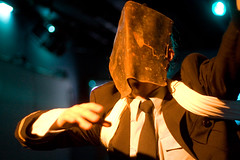
Bringing back some of the older work. Davide and Soile and Sanni have been working like crazy to get a mask theatre festival up and running, and it's looking way more promising than they'd ever thought when they first came up with the idea. We at Teatteri Metamorfoosi will be bringing back Lost Persons Area, a silent, full-face mask play about old people and death, which premiered in February 2006 and I'll be damned if I remember the choreography (or acting, or whatever you might call it, but you see silent mask acting is incredibly technical, requiring precise isolation of body parts and continuous attention, and it feels very much like you're choreographed). We'll also do another round of Kalevala dell'Arte, which combines Kalevala characters and stories with the Commedia dell'Arte style, and I'm all like hip-hooraying about that one because I just love to do it. I'm Louhi, the leader of the northern lands and the evil character, and I never knew how much I enjoyed being evil before this. It's a great show, with music, acrobatics, fighting, gags, and a couple of touching moments too.
The whole programme at metamorfoosi.com
Plus Alice, oh Alice
And tomorrow starts Alice ad infinitum in earnest. We've knocked down a wall at the Höyhentämö, taken out the auditorium, repainted, thrown half of our storage space contents away, cleaned the rest, archived, inventoried, and put away all manner of theatre stuff, and we're ordering red velvet curtains.
It feels like we've just let a whole bunch of air into the space. Well, it's bigger, and there's more work to be done, but it's great even now just to think of the space in a different way. We open on November 28.
Friday, September 07, 2007
Sunday, May 27, 2007
This is rehearsing? Ah ja...
Labels:
aarni,
akseli,
alice ad infinitum,
eki,
juha,
meditation,
performance,
rehearsal,
video,
virpi,
workshop
Thursday, March 29, 2007
Merde
It's opening night. I just picked up my notebook and thought, because every once in a while I can be frivolous, I'd share some of my notes from the last two runthroughs. Apparently I need to remember:
- pick up one of the cloths if no monkey blindfold
- tie yr damn shoelaces
- he's got a gun
- monkeys keep going, back to suitcase wild energy
- exit on humiliation
- cleaning
- no scissor gesture
- black is the colour immediately. no flowers
- bang them in the water
- silent emergency
- ophelia drowning fixed by going back w/ weight, turning R leg out, hands frozen out. sit on L leg
- just open the baby
- suitcase malfunctions
- davide needs a finger for akseli
Labels:
acting,
akseli,
davide,
devising,
here speaks elektra,
juha,
performance,
theatre
Friday, March 23, 2007
One week to Elektra
No time. No time. No time.
I am actually looking forward to performing this show; this from a person who usually prefers the rehearsal period to performing. No time. No time. Rehearsing, and when not rehearsing, designing the poster or flyer. Or programme. Or helping build lights. Or helping find costume bits. Or thinking about my application for school due in one week. Or the grant application due three days after that. And on top of that there's something in the Guardian blogs by Laura Baggaley, entitled Does it matter if we don't get paid for theatre work? and I'm all like, hell yes it does! Because if I go on like I'm going now for another thirty years, you'll have a burnt-out husk of a creative person left. I don't need to have enough for a house in Spain, but something, just something to help pay the rent has got to be there. Somehow her blog post seems like it was supposed to be a reminder of why you got into this non-paying beautiful life in the first place, which is nice to remember, but on the other hand her post is just not developed far enough and it comes off as rather hopelessly romantic.
One commenter commented well: "Having money frees you up in your thinking in that a certain level of worry ( how am I going to eat, pay the rent etc ) is removed. This level of worry has nothing to do with creating work and really only hinders it. Your ability to make good work depends on your ability to transcend your situation. Of course being over-funded can turn you into a bloated complacent so and so but let's face it being over-funded is not a situation any middle/small-scale theatre company is going to be in."
Yes, thank you.
I am actually looking forward to performing this show; this from a person who usually prefers the rehearsal period to performing. No time. No time. Rehearsing, and when not rehearsing, designing the poster or flyer. Or programme. Or helping build lights. Or helping find costume bits. Or thinking about my application for school due in one week. Or the grant application due three days after that. And on top of that there's something in the Guardian blogs by Laura Baggaley, entitled Does it matter if we don't get paid for theatre work? and I'm all like, hell yes it does! Because if I go on like I'm going now for another thirty years, you'll have a burnt-out husk of a creative person left. I don't need to have enough for a house in Spain, but something, just something to help pay the rent has got to be there. Somehow her blog post seems like it was supposed to be a reminder of why you got into this non-paying beautiful life in the first place, which is nice to remember, but on the other hand her post is just not developed far enough and it comes off as rather hopelessly romantic.
One commenter commented well: "Having money frees you up in your thinking in that a certain level of worry ( how am I going to eat, pay the rent etc ) is removed. This level of worry has nothing to do with creating work and really only hinders it. Your ability to make good work depends on your ability to transcend your situation. Of course being over-funded can turn you into a bloated complacent so and so but let's face it being over-funded is not a situation any middle/small-scale theatre company is going to be in."
Yes, thank you.
Saturday, February 17, 2007
Six weeks to Elektra
"This is your captain speaking...
I forgot what I was going to say."
So we're working now, about seven hours a day including break, until the show opens. The material is starting to gather form but it's still loose enough that anything can happen, and still doubtful enough to throw us (actors, probably director too but he doesn't show it so much in front of us) into wild rants of wtf are we doing here. This is like: the joy of devising.
Some of our elements include:
The previous week was our last "workshop" session, tomorrow marks the end of our first week of rehearsals proper. During the workshops I still had a day where I felt absolutely awful about the whole project (for reasons that are not clear even to me), but it seems that the feeling was some kind of entity itself, hanging around in the cellar air and infecting each one of us one day at a time. I have a feeling it's again just one's own artistic fear or ego or what-not making a mountain out of a molehill, where you start to question what the hell you're doing in this project and why does it have to, have to be that way when this way would be far superior, &c. I suspect what's really going on in times like those is that you just really, really secretly want the show to be great and you're building up an arsenal of excuses in case it isn't, so you won't have to go anywhere near your own personal soul's worth when your heart breaks. Maybe that's extreme. Well. It's been part of this process for sure. But this week's been an absolute giggle-fest (from hell, from Davide's POV sometimes). We've got comedy coming out the wazoo, and the project is so much fun it barely feels like Elektra.
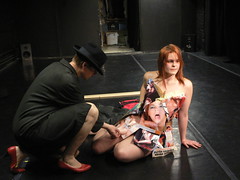
But a porn dress! How do you go wrong? Aside from the fact that I can't really move in it and that we need to build a new one every night, you can't go wrong at all!
At the moment the way we work is that the first hour is warmup and training exercises, which are either led by me (biomechanics and working on the etude) or Juha (afro warmup plus his choreography based on movements from our old show), plus a wee bit of work on singing. This is really hard to get through in an hour; I usually find that once you've warmed up the brain and the body sufficiently to do an etude at all, you've got ten minutes left. Which ten minutes, if you know the etude really well, is kinda sufficient since you'll kill yourself if you do it more than thrice in quick succession, but we're still hashing out the shifts of weight and the exact body positions, so it's a bit harried.
Oh, rewind. What's an etude? To make it an extremely short story, it's a training sequence developed for actors, in a similar vein as a kata would be in karate training: an exact sequence of movements to be executed over and over again, striving towards their perfection (which, being impossible, let's just say their improvement). You wouldn't ever use a kata in a fight: you would apply the principles you learn in it. It's the same with a biomechanical etude: you study the etude to learn, very deeply, the principles of balance, weight, mime, rhythm, breath, sensitivity, precision, and visual interest. It's not an aesthetic; it's like a barbell for your actor's body.
The shitty thing about studying biomechanics right now is that there's only a handful of people who teach it, a handful of people who use it, and they're really not in Finland at the moment. So unless I have time and money to travel to a workshop, it's kind of a self-study thing. The really brilliant thing about that is that with Juha and Akseli especially, I've taught them all I know and have quickly come to the end of my expertise, and so doing things like creating etudes for ourselves is an incredibly valuable way to challenge the principles.
And challenging the principles is, like, ridiculous. Here we are, four grown people arguing about the precise angle of a shoulder in a movement called "presenting the passport," and the angle of the shoulder really matters. Or we come up with a brillant movement only to analyze it and discover it's actually two movements, so in the interests of efficiency we have to modify its brilliant self. Or spending twenty minutes on whether a foot should be off the ground or not, and really going at it with ruthless logic. You learn an awful lot that way. So that's keeping me pretty darn happy, although you also have to truncate your learning somewhat when you're in a rehearsal situation where you actually have to produce some kind of show.
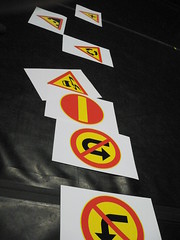
I think the fastest I've ever led the warmup was 30 minutes, and I pulled a leg muscle that day. It's amazing how long it takes us. On the other hand, we do have a lot of bits in the show so far where the idea is to push a movement beyond our capacity: to work towards complete loss of power or balance, for instance, and that requires pretty much going all out in a way that spells instant injury if your body isn't prepped like a greased pig. The choreography we made with traffic symbols is one of these. We created movements corresponding to the signs, but the movements had to be too difficult to perform properly every time—more like you stick it once every ten tries. While the movements themselves can be quite pretty, what's way, way more compelling to watch is the look on the actor's face as they will every cell in their body towards stability in a given impossible position, and it's fabulously entertaining when they crash.
What that has to do with drama per se, I can't really say. We're wondering ourselves what the dramaturgical topography is like in Here speaks Elektra, and not so much even like are we looking at a relief map or a political map or whatnot, but what the hell hemisphere is this? Is it drama, theatre, performance art, dance, dance theatre, physical theatre, does it matter as long as you can hold it together? Can you hold it together if you don't really know what it is?
By the way: we finally got a grant. Like, our first real one. We are unbelievably happy about this.
I forgot what I was going to say."
So we're working now, about seven hours a day including break, until the show opens. The material is starting to gather form but it's still loose enough that anything can happen, and still doubtful enough to throw us (actors, probably director too but he doesn't show it so much in front of us) into wild rants of wtf are we doing here. This is like: the joy of devising.
Some of our elements include:
- airports
- choreography to music as well as to traffic symbols
- a made-up biomechanical training etude called "emergency at the airport," which needs work
- a problem in dealing with stylized vs quotidien movement (i.e. when to use which and whether combining both at all will work)
- spanish tragicomedy (which is sorta like commedia pre-masks)
- a dress made out of a porn mag
- great electro soundtracks created from such sources as purring cats and a washing machine
- images, images, images, images... taped on the body, projected on the body or the set, taped to the wall; they're a total mess
- objects, objects, objects... another logistical mountain. What do you do with all the objects when you finish with them? Every single thing needs a solution. I now understand what I had thought was just a rather trendy "gradual pile-up of complete mess" stage design that seemed to be in a lot of shows that have a kind of kinship with performance art as well as theatre; they save themselves the headache of finishing with the objects.
- the order to develop a combined biomechanics and afro-dance warmup (!)
- seriously, these things just pile up
- The line "before rising to a new level of humanity, please read all instructions and comply with them"
- many beautiful moments and a lot of cheesy ones that need to (perhaps) settle into their stereotypes even deeper so they can become beautiful too
- Not really a clue as to what the costumes or staging are like
The previous week was our last "workshop" session, tomorrow marks the end of our first week of rehearsals proper. During the workshops I still had a day where I felt absolutely awful about the whole project (for reasons that are not clear even to me), but it seems that the feeling was some kind of entity itself, hanging around in the cellar air and infecting each one of us one day at a time. I have a feeling it's again just one's own artistic fear or ego or what-not making a mountain out of a molehill, where you start to question what the hell you're doing in this project and why does it have to, have to be that way when this way would be far superior, &c. I suspect what's really going on in times like those is that you just really, really secretly want the show to be great and you're building up an arsenal of excuses in case it isn't, so you won't have to go anywhere near your own personal soul's worth when your heart breaks. Maybe that's extreme. Well. It's been part of this process for sure. But this week's been an absolute giggle-fest (from hell, from Davide's POV sometimes). We've got comedy coming out the wazoo, and the project is so much fun it barely feels like Elektra.
But a porn dress! How do you go wrong? Aside from the fact that I can't really move in it and that we need to build a new one every night, you can't go wrong at all!
At the moment the way we work is that the first hour is warmup and training exercises, which are either led by me (biomechanics and working on the etude) or Juha (afro warmup plus his choreography based on movements from our old show), plus a wee bit of work on singing. This is really hard to get through in an hour; I usually find that once you've warmed up the brain and the body sufficiently to do an etude at all, you've got ten minutes left. Which ten minutes, if you know the etude really well, is kinda sufficient since you'll kill yourself if you do it more than thrice in quick succession, but we're still hashing out the shifts of weight and the exact body positions, so it's a bit harried.
Oh, rewind. What's an etude? To make it an extremely short story, it's a training sequence developed for actors, in a similar vein as a kata would be in karate training: an exact sequence of movements to be executed over and over again, striving towards their perfection (which, being impossible, let's just say their improvement). You wouldn't ever use a kata in a fight: you would apply the principles you learn in it. It's the same with a biomechanical etude: you study the etude to learn, very deeply, the principles of balance, weight, mime, rhythm, breath, sensitivity, precision, and visual interest. It's not an aesthetic; it's like a barbell for your actor's body.
The shitty thing about studying biomechanics right now is that there's only a handful of people who teach it, a handful of people who use it, and they're really not in Finland at the moment. So unless I have time and money to travel to a workshop, it's kind of a self-study thing. The really brilliant thing about that is that with Juha and Akseli especially, I've taught them all I know and have quickly come to the end of my expertise, and so doing things like creating etudes for ourselves is an incredibly valuable way to challenge the principles.
And challenging the principles is, like, ridiculous. Here we are, four grown people arguing about the precise angle of a shoulder in a movement called "presenting the passport," and the angle of the shoulder really matters. Or we come up with a brillant movement only to analyze it and discover it's actually two movements, so in the interests of efficiency we have to modify its brilliant self. Or spending twenty minutes on whether a foot should be off the ground or not, and really going at it with ruthless logic. You learn an awful lot that way. So that's keeping me pretty darn happy, although you also have to truncate your learning somewhat when you're in a rehearsal situation where you actually have to produce some kind of show.
I think the fastest I've ever led the warmup was 30 minutes, and I pulled a leg muscle that day. It's amazing how long it takes us. On the other hand, we do have a lot of bits in the show so far where the idea is to push a movement beyond our capacity: to work towards complete loss of power or balance, for instance, and that requires pretty much going all out in a way that spells instant injury if your body isn't prepped like a greased pig. The choreography we made with traffic symbols is one of these. We created movements corresponding to the signs, but the movements had to be too difficult to perform properly every time—more like you stick it once every ten tries. While the movements themselves can be quite pretty, what's way, way more compelling to watch is the look on the actor's face as they will every cell in their body towards stability in a given impossible position, and it's fabulously entertaining when they crash.
What that has to do with drama per se, I can't really say. We're wondering ourselves what the dramaturgical topography is like in Here speaks Elektra, and not so much even like are we looking at a relief map or a political map or whatnot, but what the hell hemisphere is this? Is it drama, theatre, performance art, dance, dance theatre, physical theatre, does it matter as long as you can hold it together? Can you hold it together if you don't really know what it is?
By the way: we finally got a grant. Like, our first real one. We are unbelievably happy about this.
Labels:
acting,
akseli,
biomechanics,
davide,
devising,
here speaks elektra,
juha,
meyerhold,
naamio ja höyhen,
performance,
rehearsal,
theatre,
warmup,
workshop
Tuesday, December 12, 2006
One point five rehearsals to go
I'm flying back to Canada for Christmas; I can't wait to finally meet my niece and see everyone I haven't seen for two and a half years. Just a couple more rehearsals before I go, of course. Stuff I'd like to expand on:
The Projects
Today's rehearsal is for Kalevala dell'Arte, mixing the Finnish epic with the Commedia dell'Arte style. The poetry is beautiful but none of us has a very rigorous approach to poetry (with my Shakespeare background, I seem to be the poetic text expert in the group and that's scary since I'm a total tenderfoot in the field). A few of us have a strong-ish background in Commedia, so that's at least a start. We have a musician, a dancer/choreographer, an acrobat, and a bunch of mask actors. So basically it's ambitious as hell and the training is daunting, but it could be a real hit.
Here speaks Elektra continues in the new year. We had a good discussion about why this particular last workshop segment was so difficult and painful when we all like the project and we all like working with each other. In some ways the content is responsible; you can't do a piece about torture and humiliation and expect it to have no effect on your mood whatsoever. Also we're working very personally and we keep finding that we distance ourselves from the work rather automatically, as a kind of protection. It's very frustrating to watch yourself shut down creatively in order to avoid some discomfort--you can really see it happening and have no idea how to not do it. I'm taking this as material; as a phenomenon that should be worked into the performance itself.
And then Akseli and Juha and I met on Sunday to discuss our upcoming project, with the working title Katsoin kun sinä katosit / I watched you disappear, which, if it happens in front of an audience, will happen next fall. The basic idea is for the three of us to work without a director. We have a common experience, we three, of things like butoh, biomechanics, modern dance, improvisation, and working with directors like Eero-Tapio Vuori, Atro Kahiluoto, Davide Giovanzana, Jani-Petteri Olkkonen, and choreographer Ken Mai. In a sense, their work has a unique combination in us, even though the directors themselves have little to no common artistic dialogue. And we want to crystallise what it is, exactly, that we know. How, exactly, we work as a group of actors, analysing what we have in common without having anyone else come in with new styles or ideas. To begin with, we're just planning workshops where we each take responsibility for a method/style/question and work with it for a couple of hours, and then another one takes a couple of hours, and after a few sessions we can say "I want to combine what you did with this exercise I did the other day and see what happens," and that's our beginning. We also have lots of general interest questions, from application of Laban's movement theories to the relationship between concentration in the actor and concentration in the audience, and the relationship between control and non-control between the performer and the performance. I mean, that's a start. I'm also interested in how people start to "become" each other when they work together a lot or hang out a lot or whatever. So that, in a nutshell of a nutshell, is the starting point for a project. We start training and research in January.
But first, it's back home for a bit of turkey and TLC!
The Projects
Today's rehearsal is for Kalevala dell'Arte, mixing the Finnish epic with the Commedia dell'Arte style. The poetry is beautiful but none of us has a very rigorous approach to poetry (with my Shakespeare background, I seem to be the poetic text expert in the group and that's scary since I'm a total tenderfoot in the field). A few of us have a strong-ish background in Commedia, so that's at least a start. We have a musician, a dancer/choreographer, an acrobat, and a bunch of mask actors. So basically it's ambitious as hell and the training is daunting, but it could be a real hit.
Here speaks Elektra continues in the new year. We had a good discussion about why this particular last workshop segment was so difficult and painful when we all like the project and we all like working with each other. In some ways the content is responsible; you can't do a piece about torture and humiliation and expect it to have no effect on your mood whatsoever. Also we're working very personally and we keep finding that we distance ourselves from the work rather automatically, as a kind of protection. It's very frustrating to watch yourself shut down creatively in order to avoid some discomfort--you can really see it happening and have no idea how to not do it. I'm taking this as material; as a phenomenon that should be worked into the performance itself.
And then Akseli and Juha and I met on Sunday to discuss our upcoming project, with the working title Katsoin kun sinä katosit / I watched you disappear, which, if it happens in front of an audience, will happen next fall. The basic idea is for the three of us to work without a director. We have a common experience, we three, of things like butoh, biomechanics, modern dance, improvisation, and working with directors like Eero-Tapio Vuori, Atro Kahiluoto, Davide Giovanzana, Jani-Petteri Olkkonen, and choreographer Ken Mai. In a sense, their work has a unique combination in us, even though the directors themselves have little to no common artistic dialogue. And we want to crystallise what it is, exactly, that we know. How, exactly, we work as a group of actors, analysing what we have in common without having anyone else come in with new styles or ideas. To begin with, we're just planning workshops where we each take responsibility for a method/style/question and work with it for a couple of hours, and then another one takes a couple of hours, and after a few sessions we can say "I want to combine what you did with this exercise I did the other day and see what happens," and that's our beginning. We also have lots of general interest questions, from application of Laban's movement theories to the relationship between concentration in the actor and concentration in the audience, and the relationship between control and non-control between the performer and the performance. I mean, that's a start. I'm also interested in how people start to "become" each other when they work together a lot or hang out a lot or whatever. So that, in a nutshell of a nutshell, is the starting point for a project. We start training and research in January.
But first, it's back home for a bit of turkey and TLC!
Labels:
acting,
akseli,
devising,
here speaks elektra,
juha,
kalevala dell'arte,
naamio ja höyhen,
performance,
rehearsal,
theatre,
training,
workshop
Monday, December 04, 2006
You're projecting, Frida
Careful what you ask for as an actor.
I mean, of course yeah careful what you as for as a human being, but anyway and but so. I was getting driven round the bend by the fact that I've been playing with Hamletmaschine for three years in a more than just casual fashion; it's a like 10-page script, and still I think I'm not much closer than I was at the beginning to figuring out what it's about. So last night I sat down and tried to think through what the question is. What's the problem, the experiment at the heart of Hamletmaschine, but also the rest of the work we're doing on Elektra, which so far includes:
And like a whole bunch of other things too. But I started wondering what exactly is the question we're looking for, the problem that we can try to solve. The point for me isn't to solve the problem, but to work with it and deepen our understanding of it as well as the audience's understanding. As in, if you make a show about rape, it's not so interesting to me to shock the audience, upset them or any of those things for their own sake (or even to show rape on stage), but you should be studying the phenomenon and its underlying societal assumptions/consequences and working for a deeper understanding, which to me is worth going to the theatre for. For our work I rather liked the question How much can you take? as in What exactly can you tolerate?
Can anyone say they know exactly what they will and will not tolerate? Is there a difference between tolerate and condone? If you were aware of all the daily things that happen that you would classify as intolerable and still you let them go by without blinking an eye, would that drive you crazy? Hamlets and Ophelias, in Müller's text, do pretty much just that. But it is a good question: how much are you willing to put up with? To yourself and to others? And do you really want to know exactly what you ARE putting up with right now? When something is intolerable, what do you do? Do you do nothing? Why do you do nothing? Maybe you can take more pain, injustice, and humiliation than you would really like to think.
So anyway I ended up writing this text (it basically looks like much of the above, only about ten times as long), which was just a free-for-all on the idea of tolerating, and it went over pretty well at rehearsal today. I'm happy because it relates directly to the text (although it's not the only thing you'll find there by any means), but it is also easily transferable to our physical work, because we are pushing each other to many different limits, either in exertion, or discomfort, or humiliation, which means we're all really really really good friends now, us. But so anyway I read the text out loud and Davide says "That's really nice. Can you memorize it for Wednesday?" Hell, that's 72 hours or something like that. Sure. God, it's long.
Process is a good thing, plus projecting stuff
So now we're starting to get into a pattern for our work, which is good. This time we work usually six hours, sometimes four.
First we have about 30 minutes physical warmup (running and a particular viewpoints running exercise, then enough stretching to get everything ready to work), then about a half hour rhythm exercise I developed out of a biomechanics training.
In the exercise you start by moving by yourself, making an audible rhythm with your movement on the floor by hitting with your feet and hands, trying to put your weight on feet and hands with equal frequency which means lots of cartwheely stuff (or more like trying-to-do-cartwheely stuff). Once you have your rhythm, you can play with it. Then someone gets on a drum and beats out something very, very simple. Spend about five minutes just moving to and around this rhythm, embellishing it and playing with sub-phrases in the basic rhythm but getting it into your system. Then the drum stops and the task is now, as a group, to continue the rhythm and only the rhythm, so you make noise when you hit the floor, but you only make noise where the basic rhythm is. This limitation is quite challenging for the first 3 or 4 times. Now we're getting the hang of it, so we're going to be adding more limitations and variations (kinds of movement, more emphasis on the hands than feet, silence and rhythm, using partners) to keep it pushing forward.
After that hour, Davide leads another hour of vocal work, usually starting with an exercise to acquaint yourself with 7 resonators (they correspond to 7 chakras; although in English theatre training I'm used to working with 6 resonator sounds and the seventh one is a really, really French swallowed-nasal cross between "ah" and "uh" so I kind of privately call this the French vocal warmup), followed by a period of working with improvised sound and movement. Then there's this exercise Davide invented; we call it the aquarium, and let's just say for now that it's also improvised sound and movement, but with a heavy emphasis on body part isolation and articulation, i.e. mime skills. So after the first two hours we've gotten pretty sweaty and are throwing around our bodies and voices pretty freely. It's wonderful, though, to repeat the same exercises over and over and watch the work deepen so quickly. Breakthroughs at this point are fast and furious, and that feels really, really good.
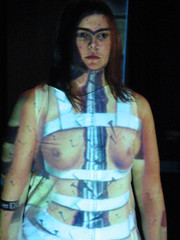
The next two to four hours are material-building. Today Virpi brought in the photos, and we worked with projecting them on a screen (hm), then on white costumes (hm), and then finally Akseli said it should really just be naked skin, and all of a sudden the images look like we might be able to use them. I mean, they're images of torture, of humiliation, they're news images. They're really awful, and whenever we've tried to work with them the actors just get completely upstaged and it's so heavy-handed. But projecting Abu Ghraib images on skin has some potential. Somehow referring to the body so strongly opens the images up; it brings some new quality to the body and to the image, and that could be strong. Plus if you're wearing a projection, you feel like you're sorta wearing something, but in a pleasing kind of naughty way.
And then, after closing the slideshow, the old theatre computer's screen saver came on: this image of Frida Kahlo's Broken Column. Akseli was standing in front of it, and all of a sudden he stepped to the place where his face and Frida's face were merging into one face, and it was mesmerizing. So we may have found something else that will work, thank you Frida.
I mean, of course yeah careful what you as for as a human being, but anyway and but so. I was getting driven round the bend by the fact that I've been playing with Hamletmaschine for three years in a more than just casual fashion; it's a like 10-page script, and still I think I'm not much closer than I was at the beginning to figuring out what it's about. So last night I sat down and tried to think through what the question is. What's the problem, the experiment at the heart of Hamletmaschine, but also the rest of the work we're doing on Elektra, which so far includes:
- [Meyerhold's] Biomechanics training (me)
- Mask/Mime/Puppets/Objects (Davide)
- Dance/Choreography (Juha's choreography)
- Singing/Music/Rhythm/Vocal sound
- Tableaux
- Heiner Müller's text
- Ancient chorus, based on Lecoq training (Davide)
- Ofeliakone/Opheliamachine
- Humiliation
- Dominant/Dominated
- The Spanish Tragicomedy [Commedia dell'Arte precursor]
- Spontaneous performance art
- Video projections
- Torture
And like a whole bunch of other things too. But I started wondering what exactly is the question we're looking for, the problem that we can try to solve. The point for me isn't to solve the problem, but to work with it and deepen our understanding of it as well as the audience's understanding. As in, if you make a show about rape, it's not so interesting to me to shock the audience, upset them or any of those things for their own sake (or even to show rape on stage), but you should be studying the phenomenon and its underlying societal assumptions/consequences and working for a deeper understanding, which to me is worth going to the theatre for. For our work I rather liked the question How much can you take? as in What exactly can you tolerate?
Can anyone say they know exactly what they will and will not tolerate? Is there a difference between tolerate and condone? If you were aware of all the daily things that happen that you would classify as intolerable and still you let them go by without blinking an eye, would that drive you crazy? Hamlets and Ophelias, in Müller's text, do pretty much just that. But it is a good question: how much are you willing to put up with? To yourself and to others? And do you really want to know exactly what you ARE putting up with right now? When something is intolerable, what do you do? Do you do nothing? Why do you do nothing? Maybe you can take more pain, injustice, and humiliation than you would really like to think.
So anyway I ended up writing this text (it basically looks like much of the above, only about ten times as long), which was just a free-for-all on the idea of tolerating, and it went over pretty well at rehearsal today. I'm happy because it relates directly to the text (although it's not the only thing you'll find there by any means), but it is also easily transferable to our physical work, because we are pushing each other to many different limits, either in exertion, or discomfort, or humiliation, which means we're all really really really good friends now, us. But so anyway I read the text out loud and Davide says "That's really nice. Can you memorize it for Wednesday?" Hell, that's 72 hours or something like that. Sure. God, it's long.
Process is a good thing, plus projecting stuff
So now we're starting to get into a pattern for our work, which is good. This time we work usually six hours, sometimes four.
First we have about 30 minutes physical warmup (running and a particular viewpoints running exercise, then enough stretching to get everything ready to work), then about a half hour rhythm exercise I developed out of a biomechanics training.
In the exercise you start by moving by yourself, making an audible rhythm with your movement on the floor by hitting with your feet and hands, trying to put your weight on feet and hands with equal frequency which means lots of cartwheely stuff (or more like trying-to-do-cartwheely stuff). Once you have your rhythm, you can play with it. Then someone gets on a drum and beats out something very, very simple. Spend about five minutes just moving to and around this rhythm, embellishing it and playing with sub-phrases in the basic rhythm but getting it into your system. Then the drum stops and the task is now, as a group, to continue the rhythm and only the rhythm, so you make noise when you hit the floor, but you only make noise where the basic rhythm is. This limitation is quite challenging for the first 3 or 4 times. Now we're getting the hang of it, so we're going to be adding more limitations and variations (kinds of movement, more emphasis on the hands than feet, silence and rhythm, using partners) to keep it pushing forward.
After that hour, Davide leads another hour of vocal work, usually starting with an exercise to acquaint yourself with 7 resonators (they correspond to 7 chakras; although in English theatre training I'm used to working with 6 resonator sounds and the seventh one is a really, really French swallowed-nasal cross between "ah" and "uh" so I kind of privately call this the French vocal warmup), followed by a period of working with improvised sound and movement. Then there's this exercise Davide invented; we call it the aquarium, and let's just say for now that it's also improvised sound and movement, but with a heavy emphasis on body part isolation and articulation, i.e. mime skills. So after the first two hours we've gotten pretty sweaty and are throwing around our bodies and voices pretty freely. It's wonderful, though, to repeat the same exercises over and over and watch the work deepen so quickly. Breakthroughs at this point are fast and furious, and that feels really, really good.
The next two to four hours are material-building. Today Virpi brought in the photos, and we worked with projecting them on a screen (hm), then on white costumes (hm), and then finally Akseli said it should really just be naked skin, and all of a sudden the images look like we might be able to use them. I mean, they're images of torture, of humiliation, they're news images. They're really awful, and whenever we've tried to work with them the actors just get completely upstaged and it's so heavy-handed. But projecting Abu Ghraib images on skin has some potential. Somehow referring to the body so strongly opens the images up; it brings some new quality to the body and to the image, and that could be strong. Plus if you're wearing a projection, you feel like you're sorta wearing something, but in a pleasing kind of naughty way.
And then, after closing the slideshow, the old theatre computer's screen saver came on: this image of Frida Kahlo's Broken Column. Akseli was standing in front of it, and all of a sudden he stepped to the place where his face and Frida's face were merging into one face, and it was mesmerizing. So we may have found something else that will work, thank you Frida.
Labels:
davide,
devising,
here speaks elektra,
lecoq,
naamio ja höyhen,
rehearsal,
theatre,
training,
workshop
Subscribe to:
Posts (Atom)