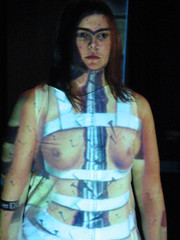
Projection of Frida Kahlo onto yrstruly
I mean, of course yeah careful what you as for as a human being, but anyway and but so. I was getting driven round the bend by the fact that I've been playing with Hamletmaschine for three years in a more than just casual fashion; it's a like 10-page script, and still I think I'm not much closer than I was at the beginning to figuring out what it's about. So last night I sat down and tried to think through what the question is. What's the problem, the experiment at the heart of Hamletmaschine, but also the rest of the work we're doing on Elektra, which so far includes:
- [Meyerhold's] Biomechanics training (me)
- Mask/Mime/Puppets/Objects (Davide)
- Dance/Choreography (Juha's choreography)
- Singing/Music/Rhythm/Vocal sound
- Tableaux
- Heiner Müller's text
- Ancient chorus, based on Lecoq training (Davide)
- Ofeliakone/Opheliamachine
- Humiliation
- Dominant/Dominated
- The Spanish Tragicomedy [Commedia dell'Arte precursor]
- Spontaneous performance art
- Video projections
- Torture
And like a whole bunch of other things too. But I started wondering what exactly is the question we're looking for, the problem that we can try to solve. The point for me isn't to solve the problem, but to work with it and deepen our understanding of it as well as the audience's understanding. As in, if you make a show about rape, it's not so interesting to me to shock the audience, upset them or any of those things for their own sake (or even to show rape on stage), but you should be studying the phenomenon and its underlying societal assumptions/consequences and working for a deeper understanding, which to me is worth going to the theatre for. For our work I rather liked the question How much can you take? as in What exactly can you tolerate?
Can anyone say they know exactly what they will and will not tolerate? Is there a difference between tolerate and condone? If you were aware of all the daily things that happen that you would classify as intolerable and still you let them go by without blinking an eye, would that drive you crazy? Hamlets and Ophelias, in Müller's text, do pretty much just that. But it is a good question: how much are you willing to put up with? To yourself and to others? And do you really want to know exactly what you ARE putting up with right now? When something is intolerable, what do you do? Do you do nothing? Why do you do nothing? Maybe you can take more pain, injustice, and humiliation than you would really like to think.
So anyway I ended up writing this text (it basically looks like much of the above, only about ten times as long), which was just a free-for-all on the idea of tolerating, and it went over pretty well at rehearsal today. I'm happy because it relates directly to the text (although it's not the only thing you'll find there by any means), but it is also easily transferable to our physical work, because we are pushing each other to many different limits, either in exertion, or discomfort, or humiliation, which means we're all really really really good friends now, us. But so anyway I read the text out loud and Davide says "That's really nice. Can you memorize it for Wednesday?" Hell, that's 72 hours or something like that. Sure. God, it's long.
Process is a good thing, plus projecting stuff
So now we're starting to get into a pattern for our work, which is good. This time we work usually six hours, sometimes four.
First we have about 30 minutes physical warmup (running and a particular viewpoints running exercise, then enough stretching to get everything ready to work), then about a half hour rhythm exercise I developed out of a biomechanics training.
In the exercise you start by moving by yourself, making an audible rhythm with your movement on the floor by hitting with your feet and hands, trying to put your weight on feet and hands with equal frequency which means lots of cartwheely stuff (or more like trying-to-do-cartwheely stuff). Once you have your rhythm, you can play with it. Then someone gets on a drum and beats out something very, very simple. Spend about five minutes just moving to and around this rhythm, embellishing it and playing with sub-phrases in the basic rhythm but getting it into your system. Then the drum stops and the task is now, as a group, to continue the rhythm and only the rhythm, so you make noise when you hit the floor, but you only make noise where the basic rhythm is. This limitation is quite challenging for the first 3 or 4 times. Now we're getting the hang of it, so we're going to be adding more limitations and variations (kinds of movement, more emphasis on the hands than feet, silence and rhythm, using partners) to keep it pushing forward.
After that hour, Davide leads another hour of vocal work, usually starting with an exercise to acquaint yourself with 7 resonators (they correspond to 7 chakras; although in English theatre training I'm used to working with 6 resonator sounds and the seventh one is a really, really French swallowed-nasal cross between "ah" and "uh" so I kind of privately call this the French vocal warmup), followed by a period of working with improvised sound and movement. Then there's this exercise Davide invented; we call it the aquarium, and let's just say for now that it's also improvised sound and movement, but with a heavy emphasis on body part isolation and articulation, i.e. mime skills. So after the first two hours we've gotten pretty sweaty and are throwing around our bodies and voices pretty freely. It's wonderful, though, to repeat the same exercises over and over and watch the work deepen so quickly. Breakthroughs at this point are fast and furious, and that feels really, really good.
The next two to four hours are material-building. Today Virpi brought in the photos, and we worked with projecting them on a screen (hm), then on white costumes (hm), and then finally Akseli said it should really just be naked skin, and all of a sudden the images look like we might be able to use them. I mean, they're images of torture, of humiliation, they're news images. They're really awful, and whenever we've tried to work with them the actors just get completely upstaged and it's so heavy-handed. But projecting Abu Ghraib images on skin has some potential. Somehow referring to the body so strongly opens the images up; it brings some new quality to the body and to the image, and that could be strong. Plus if you're wearing a projection, you feel like you're sorta wearing something, but in a pleasing kind of naughty way.
And then, after closing the slideshow, the old theatre computer's screen saver came on: this image of Frida Kahlo's Broken Column. Akseli was standing in front of it, and all of a sudden he stepped to the place where his face and Frida's face were merging into one face, and it was mesmerizing. So we may have found something else that will work, thank you Frida.