Showing posts with label training. Show all posts

Tuesday, September 18, 2007

Stuff I managed to sorta learn this week


  • A lot of lectures make a head full, especially in your second language
  • Qi gong is one of those things you have to fight your will to fight in order to get
  • You (I) can't go to bed at 02:00 and be up at 07:00 all the time
  • You can not perform something for 3 months and then pick it up again with only really minor glitches in memory and in fact find that the role has deepened while you ignored it
  • That my bike and I have a twisted relationship; or rather, I do and I'm not so sure what Betty thinks, but I'll bet she wants me to oil her chain pretty soon. I started to notice that no matter when I ride (it's only 14 minutes to school), I ride really hard. I can't seem to stop myself from hovering at an intensity that is just short of eyeballs-rolling-back-into-skull, and just on the edge of ecstatic discomfort (torture, if you like). I make noises when I ride, like basic animal ones. And I'm all like, why on earth am I like this? With myself?
  • Dramatic theatre and performance, while on a kind of continuum, really are different
  • I really, really want to find out where that border is

Lost Persons Area on Thursday, Kalevala dell'Arte on Sunday! Both at Stoa! Come see!

Monday, September 10, 2007

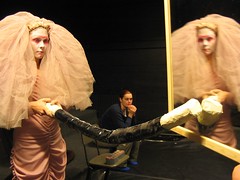
Welcome back, Alice


Cheshire cat #2
Cheshir Cat can has cheezburgr? (sorry)
Time to get back into Alice ad infinitum.

We've been trying on each other's characters and the results are terribly fun. It's somehow very satisfying to dress up as your colleague would do and try to use their character rules to build your own thing. The only problem is that if you have the same pants, you can't both be wearing them at the same time.

At the moment the main tasks are rather space and time related. As in, building new areas in the Höyhentämö (our space on Korkeavuorenkatu in Helsinki), putting up curtains, thinking about mirrors and lights, and then organizing things in order, some kind of dramaturgy, for lack of a better word. If it's not a drama, what kind of urgy are we supposed to have? We have a whole slew (and I mean a really really large number) of characters, and thankfully a smaller number of places where they exist, including places like New York, Wonderland, outer space, and in the mirror. We're still building new characters but none of them really has anything like a story attached to them, or a through-line. Everyone's leaving all the time, never to return. They kind of have encounters or situations, and then that's it. Poof, they're gone.
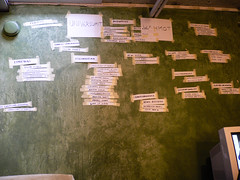

Drama(?)turgical wall
Attempting to organize
Which is not to say, I think, that the point is to not give an audience some threads to follow. I can't really say what these threads are like, but they probably will have something to do with space. Not just outer space, but where the scenes are set, where things happen in our imagination, and where things happen physically on the stage and in the whole performance area. Having something consistent is rather necessary for any kind of (even post-narrative-type) threads to get their weave on. So we'll probably have, say, a few scenes in space, a few scenes in the Looking Glass land, and so on. And if characters come back, that also helps.

In Beyond the Red Room, a piece from 2004 at Naamio ja Höyhen and also directed by Eki Vuori, there was a small space with rather tight and simple rules. Colours (created by light) indicated what kind of a world the audience was in. It wasn't the only indication, but it was a consistent throughline, and it took me many viewings of the piece (I ran lights, or colours if you like) to actually clue in to the logic. The more inconsistencies you have in a piece, the more an audience appreciates a strong, simple throughline. Films like Mullholland Drive operate with these principles. MH is disorienting enough to keep you from hoping after a watertight story, but it's not so disjointed that you can't follow or get involved in what's going on. I rather think that complete anarchy on the stage is annoying and doesn't give an audience all that much aside from the potential for a few brilliant moments. We're people. We need something to hang on to while we're shown something beautiful.

On the other hand, I'm also kind of aware of the fact that me even discussing the process in pieces like Elektra and Alice sounds a bit stupid from time to time. I don't want to explain things away, obviously, but when I say "Filthy Rabbit" I have a very clear idea of what that is and how it got into the performance, but you peeps don't. Or if I talk about Looking Glass Land or "Me-ness" in the context of this show... I feel a bit idiotic, as I know I'm not really communicating, but I just feel I have to carry on like that. I've noticed in devising theatre that some kind of common language is always developed. A group will never be able to work exactly the same way as they did last time, because the people have changed and the aims of the work have changed. So we make stuff up as we go along and because we also need to talk about it, we name it when we make it up. Which is fine for those of us working on the thing itself, but woe to anybody who has to listen to me talk about it. :)

Characters have speeches, but they're not terribly fixed. Many of them have even only been improvised once, scribbled down, maybe gone over a couple more times if they're lucky, with a bit of feedback, and that's pretty much where they are. The all-out freshness even reminds me of working with clown: you have your character's basic outline of behaviour, and then you simply pay attention to (and meticulously, lovingly, gratefully capitalize on) all the accidents that start to happen as soon as you present the character.
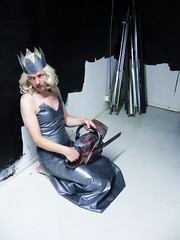


Juha's Silver Queen of Hearts
Juha puts on the silver queen
And the clothes, the makeup: they're irresistable. When trying out Akseli's filthy rabbit the other day, I started out all business: calmly and rationally get the costume, find the makeup, backcomb the hair, consider what this character will be like, and I noticed that as I was putting the finishing touches on the makeup, I was already in character. I was moving differently, doing my businesslike business with a messy and playful flair that was really for nobody but myself. Or was it for the character? What happened? Why is it that the simple act of putting on clothes can change how we are so easily and completely? I know I haven't explained it to make it nearly as interesting as I find it, but the thing is that some costumes don't really work. You can feel that they don't fit, there's no place for this thing, and you're just turning on a character from your own hard work. But then you get a costume that just starts to turn you on instead, unlocking itself gradually as you add more elements, and it's not work to do this character. It is simply the way you move, talk, and act to match the clothes.

I know I mentioned this before in an earlier post. I wanted to come back to it because it showed up again so strongly when we tried on each others' characters. And it's a fascinating question, when you think that actors can spend their entire lives training physically and vocally, practicing and thinking endlessly about a role, even rehearsing for weeks or months in rehearsal clothes, not a costume at all, and then an experiment like this comes along and makes you wonder about your previous rehearsal process. Mind, I can also sense that I'm much more sensitive to whether characters switch themselves on or whether I'm working to bring them out, because I happen to be paying attention to the process.

I'm aware that after 10 years of training, this may sound hopelessly naive. Just imagine as you wake up one day and you start to notice the mechanics of the process by which you move from sleeping to awake, and from then on you keep finding yourself waking up from time to time and noticing something new about that process, until eventually you can't wake up without observing yourself.

Friday, September 07, 2007

Back to school, back to work

So I took a few months off after all but burning myself out with Elektra, but I'm back and intend to be badder than ever. :)


Juhannus calling
Rest up

An interesting thing about physical burnout: it takes a long time to recover. Like two months even. I wouldn't say that I was really mentally burnt after last season, but I really had pushed my body to its limit. While Elektra closed in mid-May, I noticed during Kalevala warmups (it ran until June 20) that I was never even able to get my body to run properly. With jumps, balances, and basically especially stuff that involved the legs, I felt vaguely like I was in one of those dreams where the more you will yourself to run away from the knife-wielding, goalie-masked Jason, the more cemented your feet become to the ground. Eventually I learned to just take this as what was available to me now and take it easy until I got my power back, no matter how long that might take. Started taking some ballet lessons in July, and by the time August rolled around and Juha and I enrolled in a three-week intensive Afro dance course, the body was right as rain. I'm deliriously happy to be training again.

So I got into school
And it's been two weeks since my first day of a Master's program at Teatterikorkeakoulu, in Performance art & theory (Esitystaide ja -teoria). There are six of us in the class (3 foreigners, 3 Finns; 3 carnivores, 3 veggies; 3 PCs, 3 macs; so far we've been having a game out of finding all the ways we split down the middle), and the program is known around the school for being academic to the point of nerd-dom, but we're also doing a lot of practical work. I'm looking forward to the mix, becuase it's what I wanted. On this blog I've noticed a tendency to start thinking more methodically about what I do; in this program I'll have the opportunity to officially concentrate on that much. But the practical work is also essential.

My two-year project, at the moment, is basically a study of "stage presence" and how it relates to the body and mind of the performer.

That's a very, very nutshell version. I'm looking at biomechanics as a form of physical, theatrical training. I'm looking at Zen as a form of mental attention/concentration training. Technology in our lives as a source of interruption of our natural moment-to-moment presence. The audience as a source of presence itself, and how that might interact with the peformer. Presence as a trainable skill. The concept of interruption, the idea of control, and the link between what we believe we can/cannot control and our own sense of well-being. All of these things (which now make the project sound like it's branching out like a Lorenz Attractor) are sort of stuck in my head as interesting points of contact for research.

The research itself is quite the process. How does one document stage presence exactly? Video, photographs, writing? How can it be measured, if at all? Of course I'm not expecting to come up with any mathematical formulae, but it's interesting to assess the value of such subjective research. Obviously what I learn will be fairly personal and in many ways known only to me, both in my mind and body, but if I manage to communicate what I find well, I suppose that is the Big Idea. Performers aren't scientists in the way that you worked in high school chemistry, where the answers were all fixed and knowable; but when someone goes deep into an area of their artistic work, their projects can be helpful and inspiring for others. And when that person manages to communicate, at least partially, what they've found, it can really resonate with another. Quite a beautiful thought. When I pick up Peter Brook or Kristin Linklater or Anne Bogart at the library, I really cannot have any hope that they will have an easy solution to my performance questions, but what I find from time to time is a paragraph or even chapter that blows my mind, clears out a few cobwebs, and helps me point my work somewhere new. Is that what art research is really about? Is it really secretly more for creative than informative purposes?

MasQue festival in Helsinki, 20-23.9, Stoa
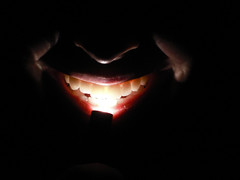
Bringing back some of the older work. Davide and Soile and Sanni have been working like crazy to get a mask theatre festival up and running, and it's looking way more promising than they'd ever thought when they first came up with the idea. We at Teatteri Metamorfoosi will be bringing back Lost Persons Area, a silent, full-face mask play about old people and death, which premiered in February 2006 and I'll be damned if I remember the choreography (or acting, or whatever you might call it, but you see silent mask acting is incredibly technical, requiring precise isolation of body parts and continuous attention, and it feels very much like you're choreographed). We'll also do another round of Kalevala dell'Arte, which combines Kalevala characters and stories with the Commedia dell'Arte style, and I'm all like hip-hooraying about that one because I just love to do it. I'm Louhi, the leader of the northern lands and the evil character, and I never knew how much I enjoyed being evil before this. It's a great show, with music, acrobatics, fighting, gags, and a couple of touching moments too.

The whole programme at metamorfoosi.com

Plus Alice, oh Alice
And tomorrow starts Alice ad infinitum in earnest. We've knocked down a wall at the Höyhentämö, taken out the auditorium, repainted, thrown half of our storage space contents away, cleaned the rest, archived, inventoried, and put away all manner of theatre stuff, and we're ordering red velvet curtains.

It feels like we've just let a whole bunch of air into the space. Well, it's bigger, and there's more work to be done, but it's great even now just to think of the space in a different way. We open on November 28.

Tuesday, December 12, 2006

One point five rehearsals to go

I'm flying back to Canada for Christmas; I can't wait to finally meet my niece and see everyone I haven't seen for two and a half years. Just a couple more rehearsals before I go, of course. Stuff I'd like to expand on:

The Projects
Today's rehearsal is for Kalevala dell'Arte, mixing the Finnish epic with the Commedia dell'Arte style. The poetry is beautiful but none of us has a very rigorous approach to poetry (with my Shakespeare background, I seem to be the poetic text expert in the group and that's scary since I'm a total tenderfoot in the field). A few of us have a strong-ish background in Commedia, so that's at least a start. We have a musician, a dancer/choreographer, an acrobat, and a bunch of mask actors. So basically it's ambitious as hell and the training is daunting, but it could be a real hit.

Here speaks Elektra continues in the new year. We had a good discussion about why this particular last workshop segment was so difficult and painful when we all like the project and we all like working with each other. In some ways the content is responsible; you can't do a piece about torture and humiliation and expect it to have no effect on your mood whatsoever. Also we're working very personally and we keep finding that we distance ourselves from the work rather automatically, as a kind of protection. It's very frustrating to watch yourself shut down creatively in order to avoid some discomfort--you can really see it happening and have no idea how to not do it. I'm taking this as material; as a phenomenon that should be worked into the performance itself.

And then Akseli and Juha and I met on Sunday to discuss our upcoming project, with the working title Katsoin kun sinä katosit / I watched you disappear, which, if it happens in front of an audience, will happen next fall. The basic idea is for the three of us to work without a director. We have a common experience, we three, of things like butoh, biomechanics, modern dance, improvisation, and working with directors like Eero-Tapio Vuori, Atro Kahiluoto, Davide Giovanzana, Jani-Petteri Olkkonen, and choreographer Ken Mai. In a sense, their work has a unique combination in us, even though the directors themselves have little to no common artistic dialogue. And we want to crystallise what it is, exactly, that we know. How, exactly, we work as a group of actors, analysing what we have in common without having anyone else come in with new styles or ideas. To begin with, we're just planning workshops where we each take responsibility for a method/style/question and work with it for a couple of hours, and then another one takes a couple of hours, and after a few sessions we can say "I want to combine what you did with this exercise I did the other day and see what happens," and that's our beginning. We also have lots of general interest questions, from application of Laban's movement theories to the relationship between concentration in the actor and concentration in the audience, and the relationship between control and non-control between the performer and the performance. I mean, that's a start. I'm also interested in how people start to "become" each other when they work together a lot or hang out a lot or whatever. So that, in a nutshell of a nutshell, is the starting point for a project. We start training and research in January.

But first, it's back home for a bit of turkey and TLC!

Monday, December 04, 2006

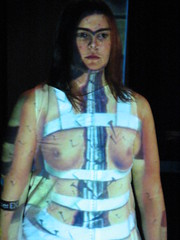
You're projecting, Frida


Me as Ophelia as Frida Kahlo
Projection of Frida Kahlo onto yrstruly
Careful what you ask for as an actor.

I mean, of course yeah careful what you as for as a human being, but anyway and but so. I was getting driven round the bend by the fact that I've been playing with Hamletmaschine for three years in a more than just casual fashion; it's a like 10-page script, and still I think I'm not much closer than I was at the beginning to figuring out what it's about. So last night I sat down and tried to think through what the question is. What's the problem, the experiment at the heart of Hamletmaschine, but also the rest of the work we're doing on Elektra, which so far includes:

  • [Meyerhold's] Biomechanics training (me)
  • Mask/Mime/Puppets/Objects (Davide)
  • Dance/Choreography (Juha's choreography)
  • Singing/Music/Rhythm/Vocal sound
  • Tableaux
  • Heiner Müller's text
  • Ancient chorus, based on Lecoq training (Davide)
  • Ofeliakone/Opheliamachine
  • Humiliation
  • Dominant/Dominated
  • The Spanish Tragicomedy [Commedia dell'Arte precursor]
  • Spontaneous performance art
  • Video projections
  • Torture

And like a whole bunch of other things too. But I started wondering what exactly is the question we're looking for, the problem that we can try to solve. The point for me isn't to solve the problem, but to work with it and deepen our understanding of it as well as the audience's understanding. As in, if you make a show about rape, it's not so interesting to me to shock the audience, upset them or any of those things for their own sake (or even to show rape on stage), but you should be studying the phenomenon and its underlying societal assumptions/consequences and working for a deeper understanding, which to me is worth going to the theatre for. For our work I rather liked the question How much can you take? as in What exactly can you tolerate?

Can anyone say they know exactly what they will and will not tolerate? Is there a difference between tolerate and condone? If you were aware of all the daily things that happen that you would classify as intolerable and still you let them go by without blinking an eye, would that drive you crazy? Hamlets and Ophelias, in Müller's text, do pretty much just that. But it is a good question: how much are you willing to put up with? To yourself and to others? And do you really want to know exactly what you ARE putting up with right now? When something is intolerable, what do you do? Do you do nothing? Why do you do nothing? Maybe you can take more pain, injustice, and humiliation than you would really like to think.

So anyway I ended up writing this text (it basically looks like much of the above, only about ten times as long), which was just a free-for-all on the idea of tolerating, and it went over pretty well at rehearsal today. I'm happy because it relates directly to the text (although it's not the only thing you'll find there by any means), but it is also easily transferable to our physical work, because we are pushing each other to many different limits, either in exertion, or discomfort, or humiliation, which means we're all really really really good friends now, us. But so anyway I read the text out loud and Davide says "That's really nice. Can you memorize it for Wednesday?" Hell, that's 72 hours or something like that. Sure. God, it's long.

Process is a good thing, plus projecting stuff
So now we're starting to get into a pattern for our work, which is good. This time we work usually six hours, sometimes four.

First we have about 30 minutes physical warmup (running and a particular viewpoints running exercise, then enough stretching to get everything ready to work), then about a half hour rhythm exercise I developed out of a biomechanics training.

In the exercise you start by moving by yourself, making an audible rhythm with your movement on the floor by hitting with your feet and hands, trying to put your weight on feet and hands with equal frequency which means lots of cartwheely stuff (or more like trying-to-do-cartwheely stuff). Once you have your rhythm, you can play with it. Then someone gets on a drum and beats out something very, very simple. Spend about five minutes just moving to and around this rhythm, embellishing it and playing with sub-phrases in the basic rhythm but getting it into your system. Then the drum stops and the task is now, as a group, to continue the rhythm and only the rhythm, so you make noise when you hit the floor, but you only make noise where the basic rhythm is. This limitation is quite challenging for the first 3 or 4 times. Now we're getting the hang of it, so we're going to be adding more limitations and variations (kinds of movement, more emphasis on the hands than feet, silence and rhythm, using partners) to keep it pushing forward.

After that hour, Davide leads another hour of vocal work, usually starting with an exercise to acquaint yourself with 7 resonators (they correspond to 7 chakras; although in English theatre training I'm used to working with 6 resonator sounds and the seventh one is a really, really French swallowed-nasal cross between "ah" and "uh" so I kind of privately call this the French vocal warmup), followed by a period of working with improvised sound and movement. Then there's this exercise Davide invented; we call it the aquarium, and let's just say for now that it's also improvised sound and movement, but with a heavy emphasis on body part isolation and articulation, i.e. mime skills. So after the first two hours we've gotten pretty sweaty and are throwing around our bodies and voices pretty freely. It's wonderful, though, to repeat the same exercises over and over and watch the work deepen so quickly. Breakthroughs at this point are fast and furious, and that feels really, really good.

The next two to four hours are material-building. Today Virpi brought in the photos, and we worked with projecting them on a screen (hm), then on white costumes (hm), and then finally Akseli said it should really just be naked skin, and all of a sudden the images look like we might be able to use them. I mean, they're images of torture, of humiliation, they're news images. They're really awful, and whenever we've tried to work with them the actors just get completely upstaged and it's so heavy-handed. But projecting Abu Ghraib images on skin has some potential. Somehow referring to the body so strongly opens the images up; it brings some new quality to the body and to the image, and that could be strong. Plus if you're wearing a projection, you feel like you're sorta wearing something, but in a pleasing kind of naughty way.

And then, after closing the slideshow, the old theatre computer's screen saver came on: this image of Frida Kahlo's Broken Column. Akseli was standing in front of it, and all of a sudden he stepped to the place where his face and Frida's face were merging into one face, and it was mesmerizing. So we may have found something else that will work, thank you Frida.

Wednesday, November 08, 2006

There's only Alice ad infinitum

So we've finished day two of workshops for Alice in infiniteland, an Eero-Tapio Vuori directed piece with Teatteri Naamio ja Höyhen, coming up one year from now.

At the moment, there are five bathroom-mirror-sized mirrors dangling from the theatre ceiling, complementing our other collection of reflective surfaces around the lobby, toilets, and dressing rooms at the theatre. We've been, for the last two sessions, experimenting with the idea of performing in a mirror. To a mirror. Performing as though nobody else is there, and then performing exactly the same thing (or similar) to an audience. You know how you're at home brushing your teeth and all of a sudden your eyebrows become interesting and fifteen minutes later you've done an eyebrow opera to nobody but yourself? That's related to this kind of thing.

When these cats did Beyond the Red Room (I just took over lights at some point) I thought it looked easy, what they were doing. It was simply a matter of presence. You switch it on, there it is. After watching it again and again I rather lost a sense of how delicate it was. Yesterday for me trying to be fully in the here and now felt like squeezing a lemon through the eye of a needle. My voice went fake, I censored myself, etc etc. Today I had a much nicer session. This probably sounds all wonky to someone who hasn't tried it or seen it, but if you've tried meditation, you'll have an idea of what it's like. It's vaguely like performing in a meditative state; it's far more active than just sitting and breathing, though. It's more the performative embodiment of the principle of Only This Moment Exists. And as with meditation, there's a profound freedom when you slip into the moment of now. In a way, other training styles like the Lecoq neutral mask also develop a similar faculty in the actor. For now in this project, it's more about gurning in a mirror and really meaning it. If that makes any sense.


Reetta in wonderland
Reetta's Alice


These are beginning experiments in transformations--where does a character begin, and where does it end? When do I say I am me, and when am I the character? If ever? Where is the limit, or if there isn't one, what does that say about acting?

I don't really want to ruin the surprise of the process, but I also rather like recording it; we did some work getting into a character with full costume and makeup, and then getting back out into "normality", and then repeating the process with an audience. It's all terribly easy or ridiculously hard depending on how you look at it, but it at least is interesting to watch. With themes like parallel universes, the psychology of an actor, Alice in Wonderland, and sexual perversity, how can you go wrong, really? Or do I need to get out of this place?