Showing posts with label acting. Show all posts

Friday, March 19, 2010

Seven days in Villa Salò, uh, probably part 1

Everybody has to have their say about Villa Salò, performance group Signa's marathon of torture and despair, which just last weekend closed its doors in Copenhagen. I wish I could say this is going to be a carefully considered essay on the time I spent there. In actuality, this is a braindump, because I guess I want some thoughts out there and also because I can't seem to do any work before I just put something damned well out. To be honest, I saw and heard and thought enough to warrant the kind of output of text you could use as a doorstop. Be warned. I was there continuously (yes, I slept there, yes it's possible with permission from the Masters, and no, I slept alone in the Hall of Orgies) for the last 4 days of the Circle of Shit, and the last three of the Circle of Blood (the final Circle).

If you don't know what the heck I'm talking about, it was a 24/7 performance installation based on the Pasolini film Salò, set in a very large (and exquisitely decorated) house, featuring 33 or so performers, visited by 5000 members of the public, and running for four alternating weeks between January and March 2010. Five types of Characters lived there: Masters, who did whatever the fuck they wanted, Madams, who were responsible for the house and its staff, Fuckers, who were bodyguards with strap-ons down to their knees, Maids, who, predictably, maided, and Children, who were usually the object of the Masters' doing whatever the fuck they wanted. Guests entered, got a membership card, received an introduction from Madam Vaccari (which she must have performed nearly a thousand times and yet it ultimately failed to prepare anybody for the house, it seems—well, with the exception of the final introduction she gave, but that's for later), and were given a coloured ribbon denoting which of the types of character in the house was their host: black for Masters' guests, red for Madams, blue for Fuckers, yellow for Maids, pink for Children.

You would be amazed at how many people think a ribbon can change your personality, or entitle (read: excuse) you to act in a manner that, well, let's say civilised folk might call assholery. You'd be amazed at an awful lot of things people thought and said and did in Villa Salò, and I'm not talking about the performers. To me, it was the audience that was, after a while, the real horrorshow. Maybe that's because I spent so much time in the Villa that I felt my perspective had more in common with the performers than with the guests. But again, more on that later. In fact, the first thing to do is send you elsewhere to read other stuff, like:

Balancing on the edge of the black hole which I now call by the name of Salò, I wonder about the road that took us this far. Never in my decade of publicly mapping the shadowlands of human despair have I known a gaze like the gaze of Salò, this forsaken house which has grown with solemn brooding amongst the kindergardens, the cafés, the unknowing passers-by of snowy, clean Østerbro. This is not the faraway castle of Marquis de Sade´s libertine protagonists, nor is it Pasolini´s desolate palace of Italian war time fascists. This is here and now, and ”the four friends” invite everyone to enter. This is certainly no S&M party, and no funhouse either. Our Salò is no more a sex show than Pasolini´s Salò is a porn film.
-Signa, 15/1 - 2010

If you read Danish or you know Google translate, you'll find no end of commentary and the odd blog post (including goddess of rum balls and burner of kitchen milk herself, Dukken), and of course it ranges from sources who never set foot in the Villa to peeps who were there even more than me (the aforementioned Dukken).

Not about me. Or, well, fuck, it is.
Ooohkay. To be honest, the hardest thing about writing about Signa is not being an asshole oneself, but if there's one thing the piece taught me is that I am as capable as anyone of laughing at misfortune—no, not misfortune, rape—and of acting (or more like not acting, which let's call it passing) in a way that keeps me in favour of whomever I want to be in favour of, even at the expense, humiliation, or torture of someone else, and possibly the worst thing, that I have a great capacity to lord it over other people, particularly when they're asking stupid questions. This is the thing. I really wouldn't like to make this about me. I am not a better or smarter or more compassionate person than others who were at Villa Salò but I have to keep telling myself that. I catch myself being selfish and superior all the time. Only Merry, glorious kitchen bitch that she was, took me down a notch from time to time. "You know, it's not all about you," she said to shut me up once over peeling an endless amount of carrots.

Oh sure, that doesn't sound like much of an admonition. But if you consider that a few hours before that I'd been in the Magistrate's room with the Magistrate, the Bishop and a few other guests when Merry came in to serve sandwiches and, in blatant trespass of the Masters' own rules, they raped her while I held the tray of sandwiches twenty centimetres away from her face and watched, then yeah, she didn't have to say much. In my defense, what else was I supposed to do? If I said stop, they would say "no" and continue. If I intervened physically, I would be subdued or restrained and, depending on my behaviour, allowed to stay or made to leave, and they would continue. If I left the room, the rape would continue. I know this because I saw it all happen again and again and again over days. In fact, any intervention was likely to prolong the torture. But you know that's not a defense, that "what was I supposed to do, I couldn't do anything" line. It is no defense at all. The point is there isn't a defense. Not for people like us, which is to say, people. Of course I feel horrible about not interrupting, of course I do. Or rather I feel horrible about not having been able to fix it. An interruption would have only made it more interesting, but a solution, a way to MAKE IT STOP, that I cannot forgive myself for not having.

And one should not forgive that. Because perhaps, one may hope, out of the realisation that in fact there is no way to stop people with money and power from doing whatever the fuck they want, that out of that realisation and in stupid defiance of it one might try to change things anyway. I find myself, in the days after the Villa, having a very short fuse as regards complacency. For ages I had accepted that CEOs would do what they liked but that really they were just people and in their situation anyone would act like that. Now I feel like a seventeen-year-old again with an oversized "fuck you I won't do what they told me" gland and no mercy whatsoever for the greedy. And, well, fuck this sounds dumb but. Haven't you ever wanted to feel like you did when you were young and and the world was completely unacceptable? Aren't you sick of the compromises you've made and the ones in others that you have let slide because fuck it, who cares, integrity is for people who don't have decisions to make? It's maybe a side-order to what Signa's intentions were, but I could never pay them back for the gift of uncompromising anger, I don't care if it only lasts a week.

Nothing to see here folks
Oh and by the way, it's theatrical, yes, by which I mean representational. Which means that Merry was never raped, not in a legal sense. That when Tonino nearly made me puke on the first day when I witnessed him being forced to eat shit, he was acting. When Bernadetta was deflowered by seven men, one right after the other, there was no real penetration. When Franchino got electric shocks on his balls, the it looked worse than it actually was. Actually, I'd need to ask Max Pross about that one, because it looked pretty bad. All of the miseries were acted exquisitely. It took me days to figure out what was "real" and what was not, and I'm left with more than a few uncertainties. I still wonder where the blood capsules are hidden, how they made the shit smell so fantastically shitty, where the hell they hid their real genitalia half of the time, or exactly how they managed to soften the whipping and slaps while making them look terrifically painful. Of course there are some marks and bruises. And I'm willing to bet a house on the claim that not a single one of those performers will ever be the same again. I doubt that any of them, however, if they had to choose again, would choose not to do Salò.

But the point is it was acted so fucking well that many guests mistook something representational for the real thing, which honestly says an awful lot about what people think about artists in general and Signa in particular. They're not torturing the performers, people. There's no need to risk STDs and infection and health in general any more than is required for such a show—the piece risks wonking the artists' view of the human race forever and that's quite enough risk already thank you. There is control, there is communication, and there is a fuckload of trust. After many days' observation, it was possible to see when things were whispered, or when the Children were fighting not to crack a smile at sadistic yet often hilarious dialogue outlining what was going to be done to them in the immediate future. I even saw it in the Duke, one of the most fearsome bastards known to man, woman, or child. And so but the next time someone (probably in performance art) tells me that representation is dead and presentation is the only way to make art... well.

And but so the thing is I have pages to write before I sleep, but this is at least a start.

Friday, October 19, 2007

Rehearsing and going insane, not necessarily in that order

First week of actually rehearsing Alice ad infinitum. What's sort of on the menu at the moment is that we've done a year and a half of developing ideas and characters and texts and scenes and situations, none of which are in any way causally related to each other or form any kind of plot, and now it's time to select the lucky winning content and string it together to form something.

It appears we're telling a story, but I mean that in the Lynchiest possible way, as in we're telling a story in a similar kind of way that Inland Empire tells a story. I can't even say if it's close to that or not at this point; it's so loose.

The first day Eki showed up with a 78-page script, which we read through, an activity that made us all giddy because it's not something that usually ends up being part of the process at N&H. The second day we worked a couple of beginning scenes, and that was fairly easy. The third day all hell (okay, small hell) broke loose with at least most of the actors. I wasn't able to get a hold of anything and was, in very good form, blaming the others for not giving me what I needed. Even when I realized that that was what I was doing, it was really hard to curb it.

Sometimes I wonder if, as performers, some of us are almost too attuned to each other. I mean, it's immediately clear to me when either Juha or Akseli are having even a 10% off day, and I know that they know when I'm not having a good day either, often before I'm even aware of it myself. Usually this is part and parcel of a very close working relationship, but it means you share a lot of the negative as well as the positive. Basically, we were doing a scene where everyone was together (not something we'd done before), and the characters were more from the classical Alice in Wonderland universe, including a dreadfully stereotypical Alice stereotyped by yours truly. We were lost and unable to give each other anything to go with. It wasn't pleasant.

But it's gone through that and has come out the other side. It's weird that we didn't really have a linear story or a main character before, and now at least in the first act we have an Alice, and her whole way of being is somewhere between the aforementioned stereotype, blank slate, and whatever else pops into my head. It's been very uncomfortable, actually, standing around trying to feel like I look like an Alice, and automatically my body was reverting to some kind of stiff caricature. Eki mentioned today that my body was way more interesting when I was just standing on stage, before I started "acting," and I realized that that zone of awful discomfort was where I was really supposed to be. This didn't make it any more comfortable at all, it just meant that if I felt kinda awful in a lost and squirmy sort of physical way, I was probably doing something right.

These are the kinds of realizations in acting that make no rational sense, and are probably not interesting to read about unless you're going through it yourself. I know I had teachers in school who tried to encourage us to find the discomfort and work with it, but the funny thing is that usually it's so glaringly strong and obvious that you can't "find" it. You just put on an attitude, feeling significantly better in the comfort department except that you know that what you're doing is completely fake and you somehow can't shake the feeling that it's not helping the piece at all, but don't know what else to do. But not knowing what to do is a very rich source.

I remember reading in Anne Bogart that stereotypes exist for a reason, and that for many actors it's a good thing to run into stereotypes instead of fleeing them, because you'll have to go through it anyway to find a way of doing a character that's actually got your real stamp on it. This worked for me in Kalevala dell'Arte (when we were building the piece, Carlo Boso called my acting "Disney commedia") and I'm inclined to think it could be a necessary phase for something like Alice. Alice is a world of stereotype, archetype, classic heroine herself. She's got more layers put on her than a Black Forest cake.

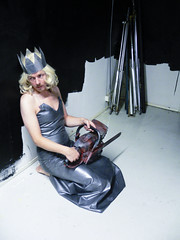
And the panic comes from the fact that three weeks ago we were happy as Larry to be playing around with perverse rabbits and queens with chainsaws, and all of a sudden there's a "real" Alice, a real Rabbit, Caterpillar, Mad Hatter, and Dormouse. And it's funny how thrown we were by trying to jump in and getting it all wrong, when we should have known that this would fuck us up, but we were still surprised.

This has to be one of the things I keep noticing these days: how I really, really keep getting surprised by things that shouldn't surprise me any more. I wonder if my artistic process is horribly inefficient. Or if that could be a good thing.

So today, here comes another loop - I've started to take on Alice in my own thinking, which is at once really encouraging and a bit sickeningly worrying. You see, Alice is confused at every turn and her identity and reality put into question. I got a direction that I completely misunderstood, and when I finally got on the boat with the others, saying, "But..what do you mean?... Oh! Now I get it," Juha burst out, "That was an Alice reaction." And from there I started to feel that Alice is more like a kind of behaviour, a state of confusion, the activity of constantly negotiating what is real and what is not, and not like any one little girl. But then I noticed I was answering questions directed at me, the actor, as Alice, the character; or as "myself through the filter of Alice the behaviour," and I started all at once to lose the sense of who exactly was answering the question. All of a sudden I didn't know where the thoughts were coming from, or to whom the question was addressed. And right after that, Juha's William S Burroughs line "Madness is confusion of levels of fact...Madness is not seeing visions but confusing levels," just about made my brain shiver.

Which is great, because this is what the heart of the project was always about: where does a character end and where does the actor begin? What are the limits of personality? Is psychology infinite?

It's one thing to be in a very physical or technically demanding performance and have to monitor yourself all the time; it's another thing entirely to do something more akin to performance art, where there is no representation or confusion of levels but you can be very attuned to your own emotional state or whatever; it's yet another thing to have the experience where, for perhaps a moment or two, you get the sensation of having merged with a character, or you feel a character start to melt with you, or you momentarily forget what you're doing, or you notice in your real life that you're picking up a character's way of responding to situations. Traditionally that's quite Method. Somehow I have the feeling that it relates more to naturalistic acting than to anything else. But whether or not it makes for a good performance, it is a real experience for the performer. I think most actors who come from a more "physical" school aren't so interested in pinpointing the place where their character separates from their own personality because that's just not terribly relevant, but for any devoted Method actor, this should be a very rich place of study, no? To try to discover what nuances make you tick, in order to make another, created personality tick in a very lively way?

I'm not making a judgement call on which kind of acting is better; obviously, there's a time and place for everything. And Eki's style isn't naturalistic at all; he uses the term "transparent acting," which I kind of have to think about a bit more before expanding on it. But now what I find interesting is that I'm consciously noticing this "melting" as a part of the process. What would happen if you could play with that even more? Consciously? With a great deal of control? Can anyone control that kind of thing? What part of me is Alice, and to what extent is Alice in everybody? To what extent am I in everybody, or everybody in me? Should I, in this performance, constantly be looking for the spot where Alice begins--is that the key to acting this time?

Monday, September 10, 2007

Welcome back, Alice


Cheshire cat #2
Cheshir Cat can has cheezburgr? (sorry)
Time to get back into Alice ad infinitum.

We've been trying on each other's characters and the results are terribly fun. It's somehow very satisfying to dress up as your colleague would do and try to use their character rules to build your own thing. The only problem is that if you have the same pants, you can't both be wearing them at the same time.

At the moment the main tasks are rather space and time related. As in, building new areas in the Höyhentämö (our space on Korkeavuorenkatu in Helsinki), putting up curtains, thinking about mirrors and lights, and then organizing things in order, some kind of dramaturgy, for lack of a better word. If it's not a drama, what kind of urgy are we supposed to have? We have a whole slew (and I mean a really really large number) of characters, and thankfully a smaller number of places where they exist, including places like New York, Wonderland, outer space, and in the mirror. We're still building new characters but none of them really has anything like a story attached to them, or a through-line. Everyone's leaving all the time, never to return. They kind of have encounters or situations, and then that's it. Poof, they're gone.


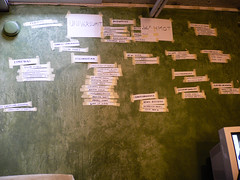
Drama(?)turgical wall
Attempting to organize
Which is not to say, I think, that the point is to not give an audience some threads to follow. I can't really say what these threads are like, but they probably will have something to do with space. Not just outer space, but where the scenes are set, where things happen in our imagination, and where things happen physically on the stage and in the whole performance area. Having something consistent is rather necessary for any kind of (even post-narrative-type) threads to get their weave on. So we'll probably have, say, a few scenes in space, a few scenes in the Looking Glass land, and so on. And if characters come back, that also helps.

In Beyond the Red Room, a piece from 2004 at Naamio ja Höyhen and also directed by Eki Vuori, there was a small space with rather tight and simple rules. Colours (created by light) indicated what kind of a world the audience was in. It wasn't the only indication, but it was a consistent throughline, and it took me many viewings of the piece (I ran lights, or colours if you like) to actually clue in to the logic. The more inconsistencies you have in a piece, the more an audience appreciates a strong, simple throughline. Films like Mullholland Drive operate with these principles. MH is disorienting enough to keep you from hoping after a watertight story, but it's not so disjointed that you can't follow or get involved in what's going on. I rather think that complete anarchy on the stage is annoying and doesn't give an audience all that much aside from the potential for a few brilliant moments. We're people. We need something to hang on to while we're shown something beautiful.

On the other hand, I'm also kind of aware of the fact that me even discussing the process in pieces like Elektra and Alice sounds a bit stupid from time to time. I don't want to explain things away, obviously, but when I say "Filthy Rabbit" I have a very clear idea of what that is and how it got into the performance, but you peeps don't. Or if I talk about Looking Glass Land or "Me-ness" in the context of this show... I feel a bit idiotic, as I know I'm not really communicating, but I just feel I have to carry on like that. I've noticed in devising theatre that some kind of common language is always developed. A group will never be able to work exactly the same way as they did last time, because the people have changed and the aims of the work have changed. So we make stuff up as we go along and because we also need to talk about it, we name it when we make it up. Which is fine for those of us working on the thing itself, but woe to anybody who has to listen to me talk about it. :)

Characters have speeches, but they're not terribly fixed. Many of them have even only been improvised once, scribbled down, maybe gone over a couple more times if they're lucky, with a bit of feedback, and that's pretty much where they are. The all-out freshness even reminds me of working with clown: you have your character's basic outline of behaviour, and then you simply pay attention to (and meticulously, lovingly, gratefully capitalize on) all the accidents that start to happen as soon as you present the character.


Juha's Silver Queen of Hearts
Juha puts on the silver queen
And the clothes, the makeup: they're irresistable. When trying out Akseli's filthy rabbit the other day, I started out all business: calmly and rationally get the costume, find the makeup, backcomb the hair, consider what this character will be like, and I noticed that as I was putting the finishing touches on the makeup, I was already in character. I was moving differently, doing my businesslike business with a messy and playful flair that was really for nobody but myself. Or was it for the character? What happened? Why is it that the simple act of putting on clothes can change how we are so easily and completely? I know I haven't explained it to make it nearly as interesting as I find it, but the thing is that some costumes don't really work. You can feel that they don't fit, there's no place for this thing, and you're just turning on a character from your own hard work. But then you get a costume that just starts to turn you on instead, unlocking itself gradually as you add more elements, and it's not work to do this character. It is simply the way you move, talk, and act to match the clothes.

I know I mentioned this before in an earlier post. I wanted to come back to it because it showed up again so strongly when we tried on each others' characters. And it's a fascinating question, when you think that actors can spend their entire lives training physically and vocally, practicing and thinking endlessly about a role, even rehearsing for weeks or months in rehearsal clothes, not a costume at all, and then an experiment like this comes along and makes you wonder about your previous rehearsal process. Mind, I can also sense that I'm much more sensitive to whether characters switch themselves on or whether I'm working to bring them out, because I happen to be paying attention to the process.

I'm aware that after 10 years of training, this may sound hopelessly naive. Just imagine as you wake up one day and you start to notice the mechanics of the process by which you move from sleeping to awake, and from then on you keep finding yourself waking up from time to time and noticing something new about that process, until eventually you can't wake up without observing yourself.

Thursday, March 29, 2007

Merde

It's opening night. I just picked up my notebook and thought, because every once in a while I can be frivolous, I'd share some of my notes from the last two runthroughs. Apparently I need to remember:

Flying
Aittomäki flying


  • pick up one of the cloths if no monkey blindfold

  • tie yr damn shoelaces

  • he's got a gun

  • monkeys keep going, back to suitcase wild energy

  • exit on humiliation

  • cleaning

  • no scissor gesture

  • black is the colour immediately. no flowers

  • bang them in the water

  • silent emergency

  • ophelia drowning fixed by going back w/ weight, turning R leg out, hands frozen out. sit on L leg

  • just open the baby

  • suitcase malfunctions

  • davide needs a finger for akseli

Saturday, February 17, 2007

Six weeks to Elektra

"This is your captain speaking...
I forgot what I was going to say."

This is a record of the artists
This is what's happening
So we're working now, about seven hours a day including break, until the show opens. The material is starting to gather form but it's still loose enough that anything can happen, and still doubtful enough to throw us (actors, probably director too but he doesn't show it so much in front of us) into wild rants of wtf are we doing here. This is like: the joy of devising.

Some of our elements include:

  • airports

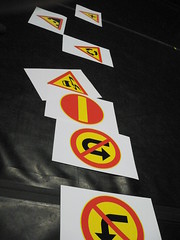
  • choreography to music as well as to traffic symbols

  • a made-up biomechanical training etude called "emergency at the airport," which needs work

  • a problem in dealing with stylized vs quotidien movement (i.e. when to use which and whether combining both at all will work)

  • spanish tragicomedy (which is sorta like commedia pre-masks)

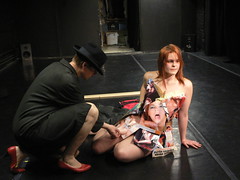
  • a dress made out of a porn mag

  • great electro soundtracks created from such sources as purring cats and a washing machine

  • images, images, images, images... taped on the body, projected on the body or the set, taped to the wall; they're a total mess

  • objects, objects, objects... another logistical mountain. What do you do with all the objects when you finish with them? Every single thing needs a solution. I now understand what I had thought was just a rather trendy "gradual pile-up of complete mess" stage design that seemed to be in a lot of shows that have a kind of kinship with performance art as well as theatre; they save themselves the headache of finishing with the objects.

  • the order to develop a combined biomechanics and afro-dance warmup (!)

  • seriously, these things just pile up

  • The line "before rising to a new level of humanity, please read all instructions and comply with them"

  • many beautiful moments and a lot of cheesy ones that need to (perhaps) settle into their stereotypes even deeper so they can become beautiful too

  • Not really a clue as to what the costumes or staging are like


12/365 10.2.2007 (other): Warning: impossible choreography
Suprisingly excellent source material
for choreography/movement
The previous week was our last "workshop" session, tomorrow marks the end of our first week of rehearsals proper. During the workshops I still had a day where I felt absolutely awful about the whole project (for reasons that are not clear even to me), but it seems that the feeling was some kind of entity itself, hanging around in the cellar air and infecting each one of us one day at a time. I have a feeling it's again just one's own artistic fear or ego or what-not making a mountain out of a molehill, where you start to question what the hell you're doing in this project and why does it have to, have to be that way when this way would be far superior, &c. I suspect what's really going on in times like those is that you just really, really secretly want the show to be great and you're building up an arsenal of excuses in case it isn't, so you won't have to go anywhere near your own personal soul's worth when your heart breaks. Maybe that's extreme. Well. It's been part of this process for sure. But this week's been an absolute giggle-fest (from hell, from Davide's POV sometimes). We've got comedy coming out the wazoo, and the project is so much fun it barely feels like Elektra.

Snip snip
Porn dress! Made of porn!

But a porn dress! How do you go wrong? Aside from the fact that I can't really move in it and that we need to build a new one every night, you can't go wrong at all!

At the moment the way we work is that the first hour is warmup and training exercises, which are either led by me (biomechanics and working on the etude) or Juha (afro warmup plus his choreography based on movements from our old show), plus a wee bit of work on singing. This is really hard to get through in an hour; I usually find that once you've warmed up the brain and the body sufficiently to do an etude at all, you've got ten minutes left. Which ten minutes, if you know the etude really well, is kinda sufficient since you'll kill yourself if you do it more than thrice in quick succession, but we're still hashing out the shifts of weight and the exact body positions, so it's a bit harried.

Oh, rewind. What's an etude? To make it an extremely short story, it's a training sequence developed for actors, in a similar vein as a kata would be in karate training: an exact sequence of movements to be executed over and over again, striving towards their perfection (which, being impossible, let's just say their improvement). You wouldn't ever use a kata in a fight: you would apply the principles you learn in it. It's the same with a biomechanical etude: you study the etude to learn, very deeply, the principles of balance, weight, mime, rhythm, breath, sensitivity, precision, and visual interest. It's not an aesthetic; it's like a barbell for your actor's body.

The shitty thing about studying biomechanics right now is that there's only a handful of people who teach it, a handful of people who use it, and they're really not in Finland at the moment. So unless I have time and money to travel to a workshop, it's kind of a self-study thing. The really brilliant thing about that is that with Juha and Akseli especially, I've taught them all I know and have quickly come to the end of my expertise, and so doing things like creating etudes for ourselves is an incredibly valuable way to challenge the principles.

10/365 8.2.2007 (other): Akseli with an image, as well
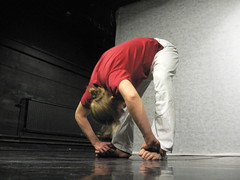
Akseli doing an old statue
And challenging the principles is, like, ridiculous. Here we are, four grown people arguing about the precise angle of a shoulder in a movement called "presenting the passport," and the angle of the shoulder really matters. Or we come up with a brillant movement only to analyze it and discover it's actually two movements, so in the interests of efficiency we have to modify its brilliant self. Or spending twenty minutes on whether a foot should be off the ground or not, and really going at it with ruthless logic. You learn an awful lot that way. So that's keeping me pretty darn happy, although you also have to truncate your learning somewhat when you're in a rehearsal situation where you actually have to produce some kind of show.

I think the fastest I've ever led the warmup was 30 minutes, and I pulled a leg muscle that day. It's amazing how long it takes us. On the other hand, we do have a lot of bits in the show so far where the idea is to push a movement beyond our capacity: to work towards complete loss of power or balance, for instance, and that requires pretty much going all out in a way that spells instant injury if your body isn't prepped like a greased pig. The choreography we made with traffic symbols is one of these. We created movements corresponding to the signs, but the movements had to be too difficult to perform properly every time—more like you stick it once every ten tries. While the movements themselves can be quite pretty, what's way, way more compelling to watch is the look on the actor's face as they will every cell in their body towards stability in a given impossible position, and it's fabulously entertaining when they crash.

What that has to do with drama per se, I can't really say. We're wondering ourselves what the dramaturgical topography is like in Here speaks Elektra, and not so much even like are we looking at a relief map or a political map or whatnot, but what the hell hemisphere is this? Is it drama, theatre, performance art, dance, dance theatre, physical theatre, does it matter as long as you can hold it together? Can you hold it together if you don't really know what it is?

By the way: we finally got a grant. Like, our first real one. We are unbelievably happy about this.

Tuesday, December 12, 2006

One point five rehearsals to go

I'm flying back to Canada for Christmas; I can't wait to finally meet my niece and see everyone I haven't seen for two and a half years. Just a couple more rehearsals before I go, of course. Stuff I'd like to expand on:

The Projects
Today's rehearsal is for Kalevala dell'Arte, mixing the Finnish epic with the Commedia dell'Arte style. The poetry is beautiful but none of us has a very rigorous approach to poetry (with my Shakespeare background, I seem to be the poetic text expert in the group and that's scary since I'm a total tenderfoot in the field). A few of us have a strong-ish background in Commedia, so that's at least a start. We have a musician, a dancer/choreographer, an acrobat, and a bunch of mask actors. So basically it's ambitious as hell and the training is daunting, but it could be a real hit.

Here speaks Elektra continues in the new year. We had a good discussion about why this particular last workshop segment was so difficult and painful when we all like the project and we all like working with each other. In some ways the content is responsible; you can't do a piece about torture and humiliation and expect it to have no effect on your mood whatsoever. Also we're working very personally and we keep finding that we distance ourselves from the work rather automatically, as a kind of protection. It's very frustrating to watch yourself shut down creatively in order to avoid some discomfort--you can really see it happening and have no idea how to not do it. I'm taking this as material; as a phenomenon that should be worked into the performance itself.

And then Akseli and Juha and I met on Sunday to discuss our upcoming project, with the working title Katsoin kun sinä katosit / I watched you disappear, which, if it happens in front of an audience, will happen next fall. The basic idea is for the three of us to work without a director. We have a common experience, we three, of things like butoh, biomechanics, modern dance, improvisation, and working with directors like Eero-Tapio Vuori, Atro Kahiluoto, Davide Giovanzana, Jani-Petteri Olkkonen, and choreographer Ken Mai. In a sense, their work has a unique combination in us, even though the directors themselves have little to no common artistic dialogue. And we want to crystallise what it is, exactly, that we know. How, exactly, we work as a group of actors, analysing what we have in common without having anyone else come in with new styles or ideas. To begin with, we're just planning workshops where we each take responsibility for a method/style/question and work with it for a couple of hours, and then another one takes a couple of hours, and after a few sessions we can say "I want to combine what you did with this exercise I did the other day and see what happens," and that's our beginning. We also have lots of general interest questions, from application of Laban's movement theories to the relationship between concentration in the actor and concentration in the audience, and the relationship between control and non-control between the performer and the performance. I mean, that's a start. I'm also interested in how people start to "become" each other when they work together a lot or hang out a lot or whatever. So that, in a nutshell of a nutshell, is the starting point for a project. We start training and research in January.

But first, it's back home for a bit of turkey and TLC!

Wednesday, November 22, 2006

From Alice's conversations with the gods


Juha's space cadet 1
"There's a black hole here. I think I'll
go visit. OOOooooOOOoo!"
On the last few days of Alice I, we spent considerably more time on theory than on character. Or rather, on characters fixated with parallel universe theory.

There was spaceship Alice, in which we dressed in white underwear and, sleeping in cyrogenic freeze, dreamt of butterflies (ref. the Chinese tale of the butterfly that dreams it is a man/man that dreams it is a butterfly), were woken up by the computer, felt a terrible cryogenic hangover, and, while brushing teeth in front of our individual mirrors, were informed that we were heading straight for a black hole. Officer Hubblefield (or Hilbertspace, nobody can ever tell one from the other) ends up being the first human black hole tourist. Stuff like this, at least stagingly speaking, has the ingenious simplicity of Star Trek: a mirror, toothbrush, and white underwear, and suddenly we're all in space. We even said it like that. "Hey guys, I'm in spaaaaace! Ooooooo! Do you read? OoooOOOoooo!"


The Max Tegmark quintet
The Max Tegmark quintet take five
Then there was the Max Tegmark quintet, who, in different Level 3 parallel universes (that's the quantum one, if you're interested), is a gambler. If he rolls a die and gets a six, Max Tegmark 2 gets a five, Max Tegmark 3 rolls a four, etc. We should be a sextet but were missing one suit. There is a Max Tegmark somewhere who gambles and always, always wins. Every permutation is played out somewhere, if space is infinite and matter infinite (that's just Level 1 parallel universe theory for you), because eventually the organization of particles will repeat itself exactly. Level 1 is the infinite-monkeys-on-infinite-typewriters version of the universe. Which means that somewhere, you're living in Japan. Somewhere, you're a heroin addict. Somewhere, you are a Hollywood star. It's all happening. How does that make you feel? Somewhere, you stop reading this post right now.

In another exercise, we quickly developed four characters (self, other self, other self far away, and Wonderland character) with the common element that they were all standing in the rain. The only rainpants I found were made of PVC; kids, they're warm. Eventually the idea became to switch between these roles with only the slightest transition, which proved to be the sort of thing that's either impossible or requires a great deal of practice. It's very hard to stay in one character, stop it entirely, and only then take on the next one--you tend to think about your upcoming character before the last one is finished. Not to mention they have physical attributes, so all of a sudden you're a Roman soldier standing at Hadrian's Wall, but your body is the shape of the Seven of Hearts. Plus the imagination takes a second to kick in with the character's environs. Plus the audience (presumably) needs some period of time to realize that X character is not Y.


Bird's perspective
Akseli with his bird's-eye-view
In other words, lightning-fast character transitions are worth more experimentation but then the question is why. Why do that at all? Why not stick to one, or take your time? Of course part of the question behind this project is the nature of the actor's psychology: where are the limits, if there are any, between actor and character? What are their properties? What is required from the actor before a character appears?

1) Costume/makeup help but are not necessary. When we started by getting into character in full view of each other (we take turns watching and doing), it was subtle but clear that as more layers and elements of costume came on, the actor's behaviour modified to match. Almost unconsciously; almost as if we couldn't help it. Sometimes we liked a character so much we didn't want to get out of costume, as if that would destroy the feeling of that character (and of course it seems to do just that).

2) Concentration/imagination or something of that ilk. You don't need costume, or a logical costume, to create a character. This feels different, though, as though your acting mixes with the power of suggestion (from the director, from your odd non-costume) to create something. It's more easy to feel unsure of yourself. My March Hare character just started out as an Adidas-wearing bunny and ended up being the front rabbit of a Rammstein-type band with a heavy German accent, and you know that character could have possibly come from nearly any costume or lack thereof, but somehow it fits. But the initial creation is less like slipping into silk stockings and more like seeing what happens when you throw anti-matter at yourself.

From the last day of Alice workshops I: session on unlimited psychology. We tried a number of different exercises to de-limit, if you like, our own psychology, to get outside it or show it. In part of mine I had a rather uncanny conversation with Juha as Juha. We felt like ourselves, ourselves both being Juha.

In another part, I had a conversation with the gods:

- What do we want to do?
- Create something. Create a character.
- I like creating characters. I would like to create a character that understands the difference between happiness and sadness but considers itself happy. Characters are experiments. They are defined by their limitations, their desires, their physical being. We are defined by limitlessness.
- But if they are experiments, they are experiments on us.
- They are “what if” versions of us. They have costumes and makeup, and motivations and problems. Sometimes they even put on makeup and costumes and play another character, but it never occurs to them that they themselves are a character. Of us. Some of them would probably want to see what is behind their own mask.
- But we have roles, too. We play gods. So we are characters.
- Of someone else?
- Yes.
- [Thinks] Where is the director?
- There is always someone directing the director.


I also used to think Eki was a bit snap-happy with the camera; I thought he really just liked recording the work. Now I see the point: with rapid-fire characters, I've already mostly forgotten what I've made in two weeks. We have to write everything down (write up in finnish), and it really helps to remember costume details. I have, for instance (names hopefully vaguely descriptive):

Cheshire cat, part 1
Smile
  • The off-with-your-nipples laugher
  • Alice in Never-Never Land
  • Pervo-Alice at the rollerskating rink
  • The Cheshire Cat
  • Cheshire Cheese-Eater/Tourette's Alice
  • Johanna in the mirror
  • White Rabbit/March Hare/Die Hasen von Hölle
  • Wolf
  • Rhinoceros
  • Butoh Queen of Hearts
  • Innocent Alice
  • 100-year-old Alice
  • Maxine Planck, theoretical physicist
  • Robert 3 (a permutation of Akseli's French bird)
  • Max Tegmark/Schoolgirl
  • Roman soldier
  • Suicide in New York
  • The Seven of Hearts

Yeah, time for a break. Alice picks up again in 2007.

Thursday, November 16, 2006

Homework for Alice, or, how devising theatre seems to work

More work on Alice. I'm going to try to be more explicit about the process so I have a decent log of our workshops. It might be a nice thing to have later... not that I couldn't scrawl it down on a notepad with a pen, but you know how the digital age is just that much more exciting.


Alice in infiniteland dramaturgy
Dramaturgy begins
Devising shows can be rocky in the dramaturgy department, even though they make up for this in being visually rich and full of well-iterated ideas. By devising I mean there's no script, or that the script does not exist at the beginning of the project, and the text and dramaturgy of the play is improvised and devleoped more or less collaboratively over the course of the rehearsal period. Generally, it seems to free the actor from psychological acting, and also every idea is tested in front of other people, which has advantages over taking your words from one other person's head.

Often the downside is the drama. Devised pieces are very frequently like a collection of vignettes that give an overall impression of a theme, rather than a coherent story. Even if a dramatic plot is the aim, coming up with one collectively is not always easy. This is not to say that pieces without a plot cannot be touching, interesting, or downright blow your mind off, but there is a place for stories onstage as well. In my mind, devised drama often works more like dance; the individual moments are emphasized rather than the through-line of the piece when creating it, and so the moments tend to be very rich. I'd rather watch Pina Bausch than Pinter anyway.

And but so we're in the second week of Alice in infiniteland, the working sort-of title for a piece going up a year from now. It's based on, well, a text message Juha received from Eki when he was in South Africa last year:

"Ens syksynä, about loka-marras-joulukuussa sarja työpajoja. Aihe
matematiikka, kvanttiteoria, alice in w, humpyn sex pervs, monen
universumin teoria, shrödingerin (irvi)kissa, valkoisen kuninkaan uni,
kiinalainen perhonen joka uneksii olevansa ihminen, solipsismi, berkley,
russelin paradoksi, koko naamari esitystilana, simultaanisuus,
itsekseen-itselleen esiintyminen, experimance, puhtaan mielikuvituksen
teatteri, safiiri ja teräs, ym. Kiinnostaako? HUOM KIRJOITA VIESTI YLÖS,
minulla ei ole sitä.: eki, infinitedramaturgialla"


I won't translate but I'm sure if you stare at words like "kvanttiteoria" long enough, you'll get quantum theory. We're not allowed to read Alice in Wonderland; we're going off the impressions we have in our memories--most of which seem to be rather similar. Everyone remembers "off with your head" and the like, and everyone also remembers (or is making up) something that nobody else recollects was there.

Usually we get to rehearsal, we have a bit of a chat, and then Eki tells us what kind of character to find. The March Hare, the Queen of Hearts, Alice, Pervo-Alice, or any character of our choosing. We go to the dressing room (which yields nothing but surprises these days) and go nuts trying to find objects and costumes to build something reminiscent of a Mad Hatter or whatever.

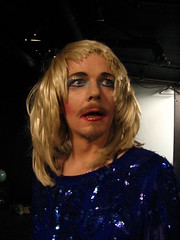
Juha's Queen of Hearts / Alice
Drag queen Alice
There are mirrors hanging around the room. We come in and present our characters, often by first going to the mirror. "Who are you?" "I'm the Queen of Hearts. I'm the drag queen of hearts." "Where are you?" "I'm in my dressing room and I'm not happy. I'm angry with my stylist. The only thing I'm happy with are these shoes. I hate my stylist. Off with his head." Before long, the character will say something that someone else picks up on and it becomes that character's trademark. Maybe we decide that character is actually someone else. Maybe it's a character for another actor.

This takes a lot of time. We rehearse officially from 16:00-24:00, but we don't usually take the whole 8 hours. The advantage to this is that you don't rush anything. The disadvantage is that I'm probably going to need to train in the mornings sometime to get my heart rate back up; this is much more challenging mentally than physically.

So the homework for next session:
- Go through Max Tegmark's article on parallel universes (PDF) and choose a number of phrases that can be your text.
- Spaceship Alice: we're all non-Alice characters who were cryogenically frozen before an accident on a spaceship. We all wear white underwear. That's all we know, but that's homework.


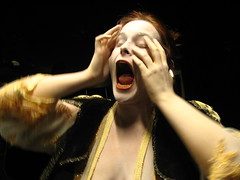
My Queen of Hearts part 1
My Queen of Hearts

This seems to be the first character I'm really happy with: the Queen of Hearts. You can't see the huge hoop skirt, and I wish I had a wig and more jewels, but I like the shoulder pieces and the body paint. It's a vaguely Elizabethan queen, which I came up with because I had been jealous of Juha's beautifully-dressed Italian Opera March Hare on Monday--I just wanted to wear something fabulous. I didn't really have an idea in my head when I got up to present the character, but I had a vague feeling of authority and beauty. Eki instead told me first to do a slow butoh-walk across the room. When I got to the mirror, he said to touch the mirror. I did, he requested that I scream. Then I could touch the mirror and scream again, and enjoy the screaming. Then turn to the audience, show them my hands as though touching the mirror, and scream. No talking, just a high-pitched wail that, if you know me, you know is the kind of inhuman noise I've been waiting for an opportunity to do in a show. Apparently that was the character. Walking silently, listening, and screaming. Eki just had the idea that he didn't want to hear this character talk; he wanted to have a character who doesn't talk at all.


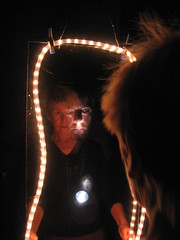
Kuka siellä
2-way mirrors

That's usually about as far as we go with the characters, just a paragraph or two of improvised song or text. In one rehearsal we might do two or three characters. After rehearsal we go and write down as much as we can possibly remember.

Akseli has a few excellent numbers so far, including a Filthy Rabbit and a Gryphon Lawyer. Virpi's Mad Hatter is so pathetically insane that it would be heartbreaking if she weren't acting. Juha's William S Burroughs/caterpillar is possibly still my favourite of his, plus his pervo-Alice, with pink wig, bitch boots, and a light saber, is a real winner. Reetta's March Hare is a circus ringmaster gone wrong; she has a bizarre tiny voice and is almost really creepy.

And the mirrors. Virpi's laboratory has created a prototype. The mirror is important for the solipsism aspect of the performance; we want to find out who these characters are when they're at home alone, not what they are when they're in front of 500 people. But the audience should see. Hence the 2-way mirror idea. With a bit of creativity in lighting, you can do an awful lot of stuff with these, mixing peoples' faces or creating a part of you that isn't your own.

Wednesday, November 08, 2006

There's only Alice ad infinitum

So we've finished day two of workshops for Alice in infiniteland, an Eero-Tapio Vuori directed piece with Teatteri Naamio ja Höyhen, coming up one year from now.

At the moment, there are five bathroom-mirror-sized mirrors dangling from the theatre ceiling, complementing our other collection of reflective surfaces around the lobby, toilets, and dressing rooms at the theatre. We've been, for the last two sessions, experimenting with the idea of performing in a mirror. To a mirror. Performing as though nobody else is there, and then performing exactly the same thing (or similar) to an audience. You know how you're at home brushing your teeth and all of a sudden your eyebrows become interesting and fifteen minutes later you've done an eyebrow opera to nobody but yourself? That's related to this kind of thing.

When these cats did Beyond the Red Room (I just took over lights at some point) I thought it looked easy, what they were doing. It was simply a matter of presence. You switch it on, there it is. After watching it again and again I rather lost a sense of how delicate it was. Yesterday for me trying to be fully in the here and now felt like squeezing a lemon through the eye of a needle. My voice went fake, I censored myself, etc etc. Today I had a much nicer session. This probably sounds all wonky to someone who hasn't tried it or seen it, but if you've tried meditation, you'll have an idea of what it's like. It's vaguely like performing in a meditative state; it's far more active than just sitting and breathing, though. It's more the performative embodiment of the principle of Only This Moment Exists. And as with meditation, there's a profound freedom when you slip into the moment of now. In a way, other training styles like the Lecoq neutral mask also develop a similar faculty in the actor. For now in this project, it's more about gurning in a mirror and really meaning it. If that makes any sense.


Reetta in wonderland
Reetta's Alice


These are beginning experiments in transformations--where does a character begin, and where does it end? When do I say I am me, and when am I the character? If ever? Where is the limit, or if there isn't one, what does that say about acting?

I don't really want to ruin the surprise of the process, but I also rather like recording it; we did some work getting into a character with full costume and makeup, and then getting back out into "normality", and then repeating the process with an audience. It's all terribly easy or ridiculously hard depending on how you look at it, but it at least is interesting to watch. With themes like parallel universes, the psychology of an actor, Alice in Wonderland, and sexual perversity, how can you go wrong, really? Or do I need to get out of this place?