I shouldn't even be writing now; my brain is about as synapse-friendly as a bowl of forgotten porridge and I could use some sleep, here, nearing six o'clock on a sunny sunny Friday.
We're about 70% labyrinth-built I think. You go in to the space and it's a mess of shelves, walls, doors that go nowhere, doors that you think go nowhere, and various other features I won't spoil. Walls made of stacks of boxes, Minos' empty bottles and bathtub, Ariadne's falling apparatus. Pilar (designer extraordinaire) is being frightfully excellent by not allowing me to cut any corners in the interests of being done earlier and letting the actors loose on the place. Damned detail-oriented designers. I know I'll be happy in the end.
So anyway I have a problem that I didn't think I needed to solve but apparently I do: I don't know what to call the people who come to Tower Room. If I call them audience, the players are irritated. If I call them players, the spectators are made nervous. If I call them participants, everybody cringes. Co-creators? Ticket holders? Initiates? Guests? The Golden Few? Seriously.
I've taken to using the terms rather interchangeably just so I can get rid of the annoying connotations, but really all that does is make a mushy imprecise mess of your language and unless people hang around you enough to hear you mixing and matching and reworking all those words, they won't understand you properly anyway. It's not like terminology catches on just because you use it. And also if I call the piece theatre, which it partially is and in my mind certainly it is, it creates a load of expectations for the audience. If I call it a game, ditto only scarier, because now people will be rushing in and looking for clues and getting six ways of active all over the piece. And if it's esitystaide or performance art or an installation, well, I don't know what the worst-case scenario is for that kind of spectator/ticket holder/person, but one might at least expect a certain kind of critical distance.
These are all normal ways to take in a piece. You go to a theatre, you expect to sit. You go to a gallery, you expect to wander. You go to a week-long larp, you expect to live there and make everything yourself and experience, not watch. What I'm interested in is the fuzzy area in between, or perhaps the process of moving back and forth between creating a piece yourself in participation, and watching the fruits of someone else's labour. This is particularly interesting for me when the artist's work (as opposed to the participant's) requires the passage of time, like in dance, theatre, music, and film... and poetry, too. These performances, while they might not be finished products (depending on whether you believe that a) they are ever finished and b) whether completion depends on a receiver), are at least prepared. They're thoroughly thought through; even if they're improvisations, you can bank on years of performance experience which may count as prior preparation.
Hermetic art isn't a problem - very often I'm perfectly happy to sit in a dark room and let David Lynch show me something from his brain for two hours, and I don't even get to talk to him afterwards and tell him how weird it was, and that's totally fine. What I want to find is a way of working hermetically--making the decisions myself or in a working group--but with the understanding that in performance, the piece will open up to participation, and not just your lip-service variety.
Of course there are aesthetic principles that I stick to and that I am not too worried about wanting to teach to other people. One is patience and listening. There's nothing worse in a band than the person who plays all the time. Sometimes not playing is the best way to play. This is such a no-brainer that I'm nearly embarassed to write it here but it seems to take effort to put listening into practice. It's just so easy to go go go, grab the bull by the horns and get lost in your own feel for the thing. I find this is also a common feature of those roleplaying games that I've been in: game designs and players alike seem to be very good at taking into account the fact that many players will be active by default. They talk and come up with ideas and plot twists, often much more than in real life--it's amazing how many times in a game someone asks something of another character, who in turn responds with a complete nonsequitur. It's to be expected; each player is trying to come up with what happens next and it interferes with the ability to listen.
When I was studying theatre in Canada it took ages to turn me into an active performer. I was shy as all get-out, as much as nobody who knows me would credit that now... but so anyway once I finally flipped the switch and swore I would NEVER be the last one to volunteer, never sit back when I could *do something, anything*, I found that to be much easier than sitting back and worrying about what the hell I was going to do when my turn finally came to do something. Much more productive. But so then now I really can't remember where I learned the opposite - was it in butoh? - where I learned the value of not doing. But it's a different variety of doing nothing than my earlier one. When you work with impulses in butoh, you might say that you're perfectly ready to be active at any time, but you just become more choosy. You tap into your environment, not just your inner voice, for things to do. This is what makes a good clown as well - they use everything that happens around them. We also took this on in Viewpoints training. Like seeing yourself in a roleplaying game as a free jazz musician - it's the listening that makes it good, when it is good. Same with butoh - you can watch a dancer and all of a sudden it's not just the dancer that amazes you, but, well, everything. Somehow the situation is dancing the dancer, and the dancer is dancing you. Ad infinitum. Et cetera. All this.
Tower Room isn't meant to be a jungle gym, nor is it a piece you sit back and enjoy. You're meant to be engaged, but you're also meant to take your time in getting into the speed and rhythm of the piece. You'll talk, but first you must listen. So the main design challenge at the moment is that I know how to make "audience people" be quiet. I know how to make "performance art" people be quiet. I know, if not how to make gamers quiet, at least how to confuse them. But how to design a piece that will get everybody on the same wavelength?
Showing posts with label teak. Show all posts
Showing posts with label teak. Show all posts
Friday, May 28, 2010

Friday, September 07, 2007
Back to school, back to work
So I took a few months off after all but burning myself out with Elektra, but I'm back and intend to be badder than ever. :)
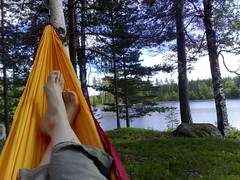
An interesting thing about physical burnout: it takes a long time to recover. Like two months even. I wouldn't say that I was really mentally burnt after last season, but I really had pushed my body to its limit. While Elektra closed in mid-May, I noticed during Kalevala warmups (it ran until June 20) that I was never even able to get my body to run properly. With jumps, balances, and basically especially stuff that involved the legs, I felt vaguely like I was in one of those dreams where the more you will yourself to run away from the knife-wielding, goalie-masked Jason, the more cemented your feet become to the ground. Eventually I learned to just take this as what was available to me now and take it easy until I got my power back, no matter how long that might take. Started taking some ballet lessons in July, and by the time August rolled around and Juha and I enrolled in a three-week intensive Afro dance course, the body was right as rain. I'm deliriously happy to be training again.
So I got into school
And it's been two weeks since my first day of a Master's program at Teatterikorkeakoulu, in Performance art & theory (Esitystaide ja -teoria). There are six of us in the class (3 foreigners, 3 Finns; 3 carnivores, 3 veggies; 3 PCs, 3 macs; so far we've been having a game out of finding all the ways we split down the middle), and the program is known around the school for being academic to the point of nerd-dom, but we're also doing a lot of practical work. I'm looking forward to the mix, becuase it's what I wanted. On this blog I've noticed a tendency to start thinking more methodically about what I do; in this program I'll have the opportunity to officially concentrate on that much. But the practical work is also essential.
My two-year project, at the moment, is basically a study of "stage presence" and how it relates to the body and mind of the performer.
That's a very, very nutshell version. I'm looking at biomechanics as a form of physical, theatrical training. I'm looking at Zen as a form of mental attention/concentration training. Technology in our lives as a source of interruption of our natural moment-to-moment presence. The audience as a source of presence itself, and how that might interact with the peformer. Presence as a trainable skill. The concept of interruption, the idea of control, and the link between what we believe we can/cannot control and our own sense of well-being. All of these things (which now make the project sound like it's branching out like a Lorenz Attractor) are sort of stuck in my head as interesting points of contact for research.
The research itself is quite the process. How does one document stage presence exactly? Video, photographs, writing? How can it be measured, if at all? Of course I'm not expecting to come up with any mathematical formulae, but it's interesting to assess the value of such subjective research. Obviously what I learn will be fairly personal and in many ways known only to me, both in my mind and body, but if I manage to communicate what I find well, I suppose that is the Big Idea. Performers aren't scientists in the way that you worked in high school chemistry, where the answers were all fixed and knowable; but when someone goes deep into an area of their artistic work, their projects can be helpful and inspiring for others. And when that person manages to communicate, at least partially, what they've found, it can really resonate with another. Quite a beautiful thought. When I pick up Peter Brook or Kristin Linklater or Anne Bogart at the library, I really cannot have any hope that they will have an easy solution to my performance questions, but what I find from time to time is a paragraph or even chapter that blows my mind, clears out a few cobwebs, and helps me point my work somewhere new. Is that what art research is really about? Is it really secretly more for creative than informative purposes?
MasQue festival in Helsinki, 20-23.9, Stoa
Bringing back some of the older work. Davide and Soile and Sanni have been working like crazy to get a mask theatre festival up and running, and it's looking way more promising than they'd ever thought when they first came up with the idea. We at Teatteri Metamorfoosi will be bringing back Lost Persons Area, a silent, full-face mask play about old people and death, which premiered in February 2006 and I'll be damned if I remember the choreography (or acting, or whatever you might call it, but you see silent mask acting is incredibly technical, requiring precise isolation of body parts and continuous attention, and it feels very much like you're choreographed). We'll also do another round of Kalevala dell'Arte, which combines Kalevala characters and stories with the Commedia dell'Arte style, and I'm all like hip-hooraying about that one because I just love to do it. I'm Louhi, the leader of the northern lands and the evil character, and I never knew how much I enjoyed being evil before this. It's a great show, with music, acrobatics, fighting, gags, and a couple of touching moments too.
The whole programme at metamorfoosi.com
Plus Alice, oh Alice
And tomorrow starts Alice ad infinitum in earnest. We've knocked down a wall at the Höyhentämö, taken out the auditorium, repainted, thrown half of our storage space contents away, cleaned the rest, archived, inventoried, and put away all manner of theatre stuff, and we're ordering red velvet curtains.
It feels like we've just let a whole bunch of air into the space. Well, it's bigger, and there's more work to be done, but it's great even now just to think of the space in a different way. We open on November 28.
Rest up
An interesting thing about physical burnout: it takes a long time to recover. Like two months even. I wouldn't say that I was really mentally burnt after last season, but I really had pushed my body to its limit. While Elektra closed in mid-May, I noticed during Kalevala warmups (it ran until June 20) that I was never even able to get my body to run properly. With jumps, balances, and basically especially stuff that involved the legs, I felt vaguely like I was in one of those dreams where the more you will yourself to run away from the knife-wielding, goalie-masked Jason, the more cemented your feet become to the ground. Eventually I learned to just take this as what was available to me now and take it easy until I got my power back, no matter how long that might take. Started taking some ballet lessons in July, and by the time August rolled around and Juha and I enrolled in a three-week intensive Afro dance course, the body was right as rain. I'm deliriously happy to be training again.
So I got into school
And it's been two weeks since my first day of a Master's program at Teatterikorkeakoulu, in Performance art & theory (Esitystaide ja -teoria). There are six of us in the class (3 foreigners, 3 Finns; 3 carnivores, 3 veggies; 3 PCs, 3 macs; so far we've been having a game out of finding all the ways we split down the middle), and the program is known around the school for being academic to the point of nerd-dom, but we're also doing a lot of practical work. I'm looking forward to the mix, becuase it's what I wanted. On this blog I've noticed a tendency to start thinking more methodically about what I do; in this program I'll have the opportunity to officially concentrate on that much. But the practical work is also essential.
My two-year project, at the moment, is basically a study of "stage presence" and how it relates to the body and mind of the performer.
That's a very, very nutshell version. I'm looking at biomechanics as a form of physical, theatrical training. I'm looking at Zen as a form of mental attention/concentration training. Technology in our lives as a source of interruption of our natural moment-to-moment presence. The audience as a source of presence itself, and how that might interact with the peformer. Presence as a trainable skill. The concept of interruption, the idea of control, and the link between what we believe we can/cannot control and our own sense of well-being. All of these things (which now make the project sound like it's branching out like a Lorenz Attractor) are sort of stuck in my head as interesting points of contact for research.
The research itself is quite the process. How does one document stage presence exactly? Video, photographs, writing? How can it be measured, if at all? Of course I'm not expecting to come up with any mathematical formulae, but it's interesting to assess the value of such subjective research. Obviously what I learn will be fairly personal and in many ways known only to me, both in my mind and body, but if I manage to communicate what I find well, I suppose that is the Big Idea. Performers aren't scientists in the way that you worked in high school chemistry, where the answers were all fixed and knowable; but when someone goes deep into an area of their artistic work, their projects can be helpful and inspiring for others. And when that person manages to communicate, at least partially, what they've found, it can really resonate with another. Quite a beautiful thought. When I pick up Peter Brook or Kristin Linklater or Anne Bogart at the library, I really cannot have any hope that they will have an easy solution to my performance questions, but what I find from time to time is a paragraph or even chapter that blows my mind, clears out a few cobwebs, and helps me point my work somewhere new. Is that what art research is really about? Is it really secretly more for creative than informative purposes?
MasQue festival in Helsinki, 20-23.9, Stoa
Bringing back some of the older work. Davide and Soile and Sanni have been working like crazy to get a mask theatre festival up and running, and it's looking way more promising than they'd ever thought when they first came up with the idea. We at Teatteri Metamorfoosi will be bringing back Lost Persons Area, a silent, full-face mask play about old people and death, which premiered in February 2006 and I'll be damned if I remember the choreography (or acting, or whatever you might call it, but you see silent mask acting is incredibly technical, requiring precise isolation of body parts and continuous attention, and it feels very much like you're choreographed). We'll also do another round of Kalevala dell'Arte, which combines Kalevala characters and stories with the Commedia dell'Arte style, and I'm all like hip-hooraying about that one because I just love to do it. I'm Louhi, the leader of the northern lands and the evil character, and I never knew how much I enjoyed being evil before this. It's a great show, with music, acrobatics, fighting, gags, and a couple of touching moments too.
The whole programme at metamorfoosi.com
Plus Alice, oh Alice
And tomorrow starts Alice ad infinitum in earnest. We've knocked down a wall at the Höyhentämö, taken out the auditorium, repainted, thrown half of our storage space contents away, cleaned the rest, archived, inventoried, and put away all manner of theatre stuff, and we're ordering red velvet curtains.
It feels like we've just let a whole bunch of air into the space. Well, it's bigger, and there's more work to be done, but it's great even now just to think of the space in a different way. We open on November 28.
Subscribe to:
Posts (Atom)